Sacred Feminine
Jun 25, 2026
·
9 min read
Hecate: The Goddess of the Crossroads and Triple Moon Magic
🕯 7 min read · June 25, 2026
Hecate: The Goddess of the Crossroads and Triple Moon Magic
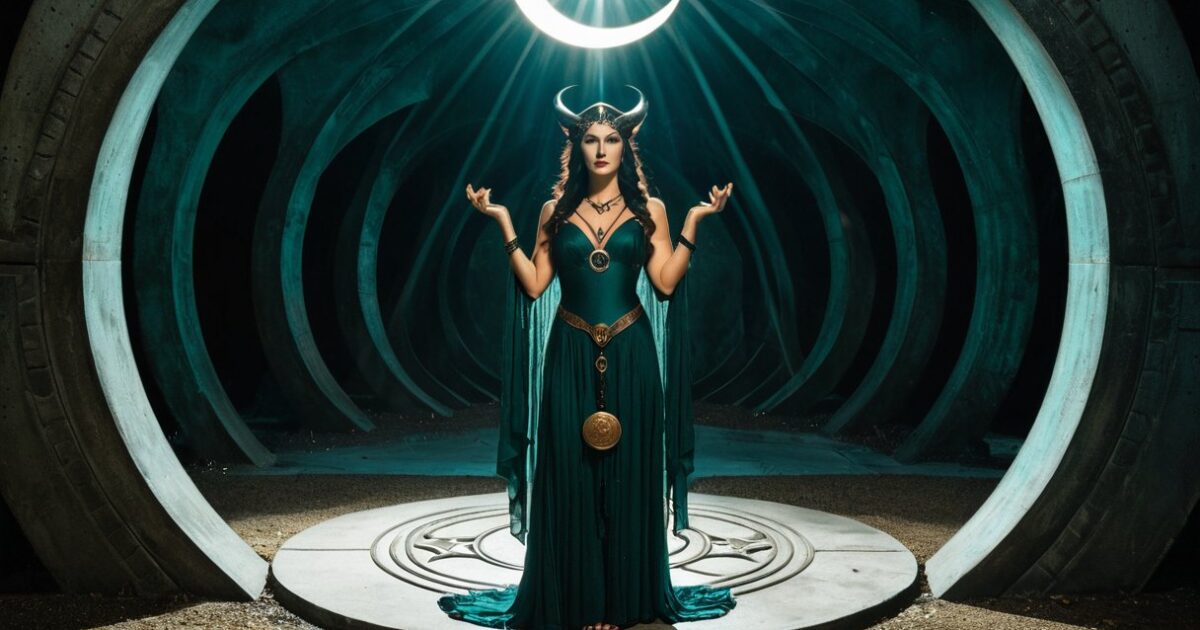
Have you ever stood at a threshold in your life, feeling the heavy silence of a decision that could alter the trajectory of your existence? Perhaps it was a career change, the end of a long relationship, or the sudden realization that the identity you have worn for a decade no longer fits. In those moments of profound uncertainty, we are standing at a spiritual crossroads. In the ancient Greek tradition, this is the domain of Hecate, the torch-bearer and the guardian of the liminal spaces.
Hecate is often misunderstood in modern pop culture as a goddess of darkness or malice. However, a deeper study of her mythology and her role in the sacred feminine reveals a deity of transition, wisdom, and the courage required to face the unknown. She is the guide who holds the light when the path ahead is obscured, teaching us that the dark is not a place of fear, but a place of preparation.
The Archetype of the Liminal Space
To understand Hecate is to understand the concept of liminality. Derived from the Latin word limen, meaning threshold, liminality is the state of being between two things. It is the dawn between night and day, the hallway between rooms, and the psychological state of transition between who we were and who we are becoming.
From a Jungian perspective, Hecate represents the Shadow archetype. Carl Jung described the Shadow as the unconscious aspect of the personality which the conscious ego does not identify in itself. By embracing Hecate, the practitioner is not seeking to invite darkness, but rather to integrate the hidden parts of the self. This process of individuation allows a person to become whole by acknowledging their fears, regrets, and untapped potentials.
Hecate does not remove the obstacle from the path; instead, she provides the torch. She represents the mental clarity and spiritual fortitude needed to make a choice with intention. When we invoke her energy, we are essentially committing to a process of honest self-examination and courageous decision-making.
The Triple Moon and the Cycle of Existence
The association of Hecate with the Triple Moon—the Waxing, Full, and Waning phases—mirrors the biological and spiritual cycles of the feminine experience. This triad reflects the Maiden, the Mother, and the Crone, representing the trajectory of growth, sustenance, and wisdom.
The Waxing Moon is the phase of initiation and intention. It is the energy of the Maiden, characterized by curiosity and the spark of new beginnings. In this stage, the focus is on planting seeds and setting clear objectives.
The Full Moon is the peak of manifestation and power. It is the energy of the Mother, representing the fullness of being and the height of emotional intensity. This is the time for celebration and the realization of effort.
The Waning Moon is the phase of release and introspection. This is the realm of the Crone, the stage of Hecate in her most potent form. It is the time for shedding what no longer serves us, cleaning the psychic slate, and honoring the necessity of endings. Without the waning phase, there can be no new growth. Hecate teaches us that the act of letting go is as sacred as the act of receiving.
Integrating Hecate into Modern Mindfulness
While the ancient Greeks offered Hecate meals at the crossroads, the modern practitioner can engage with her energy through grounded, psychological, and somatic practices. Integrating the energy of the crossroads is less about supernatural intervention and more about developing a disciplined mind.
Somatic Grounding and Presence
To navigate a transition, one must first be present in their body. Iyengar yoga emphasizes precision and alignment, which serves as a physical metaphor for the stability Hecate provides. By practicing a steady Tadasana (Mountain Pose), you create a physical center of gravity. This grounding prevents the anxiety of the unknown from pulling you into a state of panic, allowing you to observe your options from a place of stillness.
The Psychology of the Choice
When facing a crossroads, the mind often enters a loop of analysis paralysis. To break this, one can use the framework of Mindfulness Based Stress Reduction (MBSR). This involves observing the fear of the decision without judgment. Instead of asking Which choice is right?, the practitioner asks What is the truth of this moment? This shift moves the focus from a fear of the future to an awareness of the present, which is where the actual power of choice resides.
Practical Application: A Night of Reflection
If you find yourself at a crossroads tonight, you can perform a simple, grounded ritual of reflection. This is not intended to predict the future, but to clarify your internal compass.
Step 1: Create a quiet space. Dim the lights or light a single candle to represent the torch of Hecate. Ensure you are in a space where you will not be interrupted.
Step 2: The physical clearing. Cleanse your immediate environment. This can be as simple as tidying your desk or sweeping the floor. This physical act signals to the subconscious that you are making room for new clarity.
Step 3: The written inventory. Divide a piece of paper into three columns: The Past (what I am leaving behind), The Present (where I stand now), and The Potential (what I am moving toward). Be honest and specific. Avoid vague desires; instead, write tangible truths.
Step 4: The act of release. Identify one habit, belief, or resentment listed in The Past column. Safely burn that specific slip of paper in the candle flame or tear it into small pieces. As you do this, acknowledge that you are not losing something, but rather reclaiming the energy that was tied up in that burden.
Step 5: The silent commitment. Sit in silence for five minutes. Focus on your breath, feeling the weight of your body against the chair. Affirm your willingness to walk the path, regardless of the difficulty.
Safety Note: When using candles or fire, always keep a fire extinguisher or water nearby and never leave a flame unattended.
Tools of Insight: Tarot and Runes
Many who follow the path of the sacred feminine use the Rider Waite Smith (RWS) tarot or the Elder Futhark runes as mirrors for the subconscious. It is important to approach these tools not as fortune-telling devices, but as prompts for introspection.
In the RWS tarot, cards like The High Priestess or The Hermit echo Hecate’s energy of inner wisdom and solitude. Drawing a card is not about revealing a fixed fate, but about highlighting a perspective you may have ignored. If you draw a card representing conflict, the question is not Will I have a fight?, but rather Where am I creating conflict within myself?
Similarly, the Elder Futhark runes can be used as archetypal anchors. A rune like Algiz, representing protection and higher consciousness, encourages the practitioner to look at the bigger picture. These tools act as a bridge between the conscious mind and the intuition, allowing the practitioner to access insights that are already present but buried under the noise of daily stress.
The Wisdom of the Dark
The most profound lesson Hecate offers is the acceptance of the dark. In a society that prizes constant productivity and visibility, the idea of the dark is often feared. However, in nature, the dark is where the soil regenerates and where the seed germinates.
Hecate reminds us that there is a necessity to the void. There are periods in our lives where we are neither who we were nor who we will be. This gap is the liminal space. Instead of rushing through this period with anxiety, Hecate invites us to dwell there for a while. She teaches us that the darkness is not a wall, but a veil. When we stop fighting the uncertainty, we begin to see the path that was invisible to us when we were blinded by the glare of expectation.
By embracing the Triple Moon magic—the growth, the peak, and the release—we align ourselves with the natural rhythms of existence. We learn that every ending is a prerequisite for a beginning, and that the guardian of the crossroads is not there to judge our choice, but to ensure we make it with our eyes wide open.
The journey of self-discovery is rarely a straight line; it is a series of turns, detours, and returns. By honoring the energy of Hecate, we acknowledge that the most important journey is the one that leads us back to our own authentic center. In the silence of the crossroads, we find that the light we were seeking from the outside was actually the torch we were carrying all along.
Frequently Asked Questions
Does invoking Hecate mean I am practicing a specific religion?
Not necessarily. Many people engage with Hecate as a psychological archetype or a symbol of the sacred feminine to aid in personal growth and mindfulness without adhering to a formal religious structure.
Can tarot or runes tell me exactly which path to take at a crossroads?
No. These tools are designed for introspection and reflecting on current energies; they do not predict a fixed fate or provide objective directions for life decisions.
Is the Triple Moon magic only for women?
No. The cycles of growth, manifestation, and release are universal human experiences, and the archetypes of the Maiden, Mother, and Crone can be applied to any gender as stages of psychological development.
This page describes what the Sacred Feminine tradition teaches and how people practise it. It is not a prediction and not medical, psychiatric or crisis advice. How we research and write · report an error