Manifestation
Jun 20, 2026
·
15 min read
·
Updated Jul 26, 2026
Vision Board Guide: How to Create One That Actually Works in 2026
🕯 12 min read · June 20, 2026
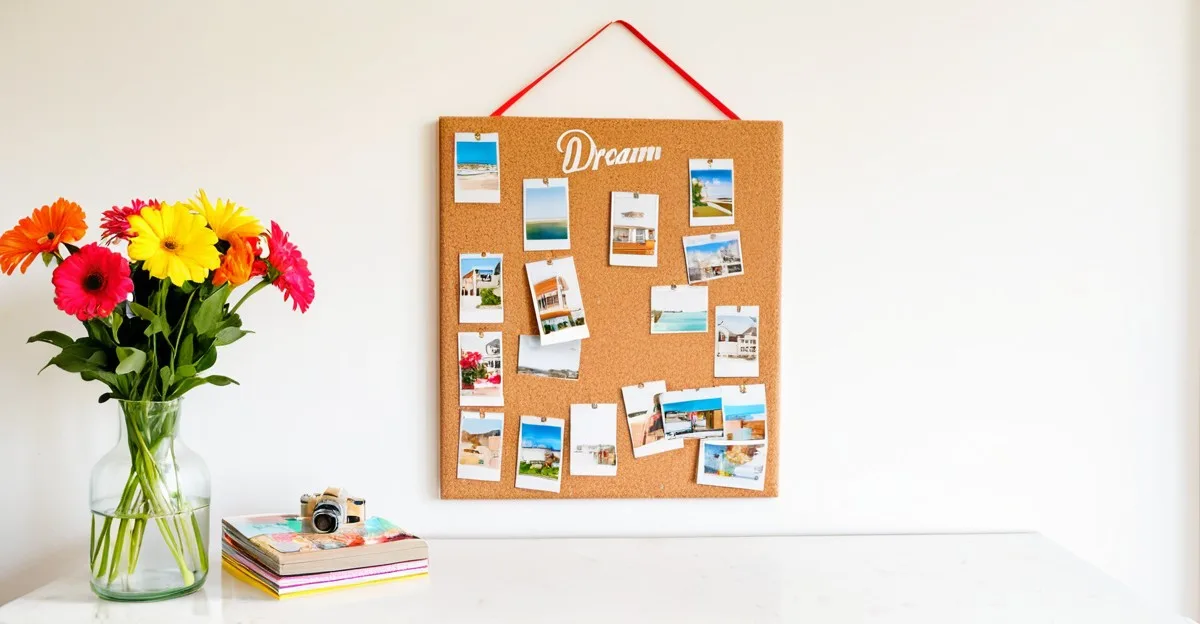
A vision board is a curated collection of images, words, and symbols that represent your goals and desired life — arranged and displayed where you see them daily. The practice draws on visualisation psychology, manifestation principles, and the neuroscience of directed attention to turn abstract desires into concrete, emotionally charged focal points that the subconscious mind can act on.
Vision boards became mainstream after The Secret (2006), but the underlying science predates that by decades. This guide covers the research, the genuine mechanics, and the specific design and placement decisions that determine whether a vision board changes anything or simply becomes decoration.
Why Vision Boards Work (and When They Don’t)
The fundamental mechanism is RAS priming: when you regularly expose yourself to visual representations of your goals, your Reticular Activating System — the neural filter that determines what your conscious mind notices — updates its filtering criteria. You begin noticing opportunities, conversations, books, and information relevant to your goals that you would previously have filtered out as noise.
A 2011 study from the Dominican University of California (Dr. Gail Matthews) found that people who wrote down their goals and reviewed them weekly were 42% more likely to achieve them than those who didn’t. Vision boards extend this by adding the emotional activation of imagery and the daily repetition of visual exposure.
Vision boards fail when:
- Passive consumption: You glance at it daily without engaging emotionally. The board must be actively felt, not just seen.
- Wrong emotional tone: Images that trigger envy, inadequacy, or comparison rather than inspiration and expectation.
- No action component: Vision boards create the mental priming that supports action — they cannot substitute for it.
- Too many goals: A board with 40 competing desires diffuses focus. The subconscious needs clarity to prioritise.
The Two Types of Vision Boards
Before creating your board, decide which approach serves your current stage:
The Dream Board (Aspiration-focused)
Represents a future 3-10 years out — the life you are building toward. This type works best when you have a clear sense of direction and want to keep it emotionally alive during the long journey. Images are aspirational: the home, the body, the relationship quality, the creative work, the travel, the freedom.
The Manifestation Board (Process-focused)
Represents a specific 12-month goal or set of complementary goals. More targeted, more emotionally immediate. Images combine the end state with the feelings and daily experiences you want — not just “the mansion” but images that represent how you want to feel in your home: peaceful, spacious, welcoming.
Most people benefit from a manifestation board style rather than the sprawling dream board — specific focus creates specific priming.
What to Include: Images, Words, and Anchors
Images First
The brain processes images 60,000 times faster than text. Your images are the primary mechanism. For each goal area, look for images that carry the emotional resonance of already having it — not images that make you feel the distance between here and there.
Useful image categories:
- Images of the specific outcome (the type of home, the type of body, the location)
- Images of the experience (how it feels to have it) — a woman laughing freely represents joy in health better than a “perfect” body image
- Images of the process (the creative studio, the morning routine, the type of work)
- Nature imagery representing states: ocean for peace, mountains for strength, sunrise for new beginnings
Avoid: images that make you feel inadequate rather than inspired; images of other people’s faces (unless they represent a specific relationship quality you’re cultivating); images so aspirational they feel unreal.
Power Words
Select 5-8 single words or short phrases that act as anchors. These should be words that, when you read them, shift your state: Freedom. Enough. Radiant. Loved. Rooted. Creative. Abundant. Spacious. Place them where the eye naturally lands.
Affirmation Quotes
Include 1-3 short quotes (under 15 words) from people whose lives or thinking you respect. Quotes carry encoded emotional authority that pure imagery doesn’t.
Physical vs. Digital Vision Boards
Physical Boards
Research consistently shows that physical creation — cutting, arranging, gluing — encodes intentions more deeply than digital assembly. The act of searching through physical magazines, feeling the weight of the images, and placing them deliberately is itself a ritual of commitment. Use a foam board, cork board, or blank canvas. Place it where you see it first thing in the morning and last thing at night.
Digital Boards
Pinterest boards, Canva collages, or a curated image folder serve as a usable alternative when physical creation isn’t practical. A digital board set as your phone wallpaper or computer screensaver gets high-frequency exposure. Apps like Hay House Vision Board offer guided digital creation. The key limitation: without the physical creation process, you must be more deliberate about the activation practice.
The Activation Practice: Turning Looking Into Manifesting
Seeing your board without activation is like exercising while scrolling your phone — technically present, but missing the mechanism.
A 5-minute morning activation practice:
- Stand or sit comfortably in front of your board
- Take three slow breaths to deactivate the stress response
- Look at each section for 15-30 seconds
- As you look, say or think: “This is my reality now” or “Thank you for this” — not “I want this” (future tense blocks the RAS signal)
- Feel — even briefly — the emotion of already having it. Gratitude is the most powerful activation emotion.
- End with 30 seconds of looking at the whole board as a complete image of your life
Theme Boards: A More Advanced Approach
Rather than one general vision board, many experienced practitioners use separate themed boards:
- Health & Body Board: Images representing physical energy, movement, specific health goals, food you love
- Career & Creativity Board: The work you do, how you want to spend your days, financial symbols, creative expression
- Relationships Board: Partnership qualities, friendship, family, community
- Home & Environment Board: How your spaces look and feel, locations you want to live in or visit
- Inner Life Board: Spiritual practice, peace, growth, the person you are becoming
Place each board in the relevant space: the health board near your workout space or bathroom mirror; the career board in your workspace; the relationships board in a shared living space.
When to Update Your Vision Board
A board that no longer resonates is actively unhelpful — images that trigger obligation rather than inspiration create negative priming. Review your board every 3-4 months.
Remove images that have manifested (celebrate!), images that no longer feel relevant, and images that trigger comparison rather than inspiration. Add images reflecting your current next step rather than a distant horizon. Many people create new boards at the new year, at each equinox/solstice, or at meaningful personal milestones.
Frequently Asked Questions
How often should I look at my vision board?
Twice daily — morning and evening — for a minimum of 2-3 minutes each session with full emotional engagement. Morning primes your RAS for the day; evening plants intentions in the subconscious during sleep. Passive glancing throughout the day is bonus reinforcement but cannot replace the deliberate activation sessions. Quality of attention is far more important than number of glances.
Should I put my vision board somewhere private or somewhere visible?
Ideally, somewhere you see it privately during your activation practice — on the wall across from your bed, in your bathroom, or at your desk. Vision boards work through your consistent emotional engagement, not through being seen by others. In fact, sharing your board widely before the goals have manifested can dilute the energy through social analysis and others’ skepticism. Keep it visible to you; share selectively.
Can I create a vision board for someone else, like a partner?
You can co-create a shared vision board with a partner for shared goals — a home you want to build together, a lifestyle you’re designing together. This works when both parties are genuinely aligned on the images and genuinely engaged in the activation practice. Creating a board for someone else based on what you want for them is a form of the same problem as manifesting specific outcomes for others — it bypasses their own intentionality.
What is the best time to create a vision board?
New Year’s Day is traditional and uses natural cultural momentum well. But any energetically meaningful time works: your birthday (personal new year), the new moon (beginning of a new lunar cycle — particularly potent for manifestation work), a solstice or equinox, or any personal transition point (after completing a major project, after a move, after a relationship ends). The most important factor is your emotional readiness: create your board when you feel genuinely open, clear, and forward-looking.
Vision Boards in Depth Psychology and Spirituality
While often framed in modern self-help terms, the vision board practice resonates deeply with ancient spiritual and psychological wisdom. Carl Jung’s concept of the “collective unconscious” and its archetypes speaks to the power of universal symbols to evoke profound emotional and psychological responses. When we select images of a nurturing home, a wise elder, or a journey across the ocean, we are not just picking pretty pictures; we are tapping into archetypal energies that transcend personal experience and resonate with deeper layers of the psyche.
Jungian analyst Dr. Clarissa Pinkola Estés, in her seminal work Women Who Run With the Wolves, emphasizes the importance of imagery and storytelling in accessing and integrating the wild, intuitive self. A vision board, in this context, becomes a personal myth-making tool, a visual narrative of the soul’s longing and potential. It’s a way to externalize and concretize the inner landscape, making it accessible for conscious engagement.
From a spiritual perspective, many traditions utilize visual aids for contemplation and intention setting. Mandalas in Hinduism and Buddhism, for instance, are intricate geometric designs used as spiritual teaching tools and aids to meditation, representing the cosmos or a divine dwelling. Similarly, “thankas” in Tibetan Buddhism are painted or embroidered religious scrolls depicting deities or mandalas, used as objects of veneration and meditation. The vision board, while secular in its common application, echoes this ancient practice of creating a sacred visual space to focus intention and elevate consciousness.
Even practices like the use of sigils in ceremonial magic, where an intention is condensed into a symbolic glyph, highlight the power of visual symbols to bypass the conscious mind and communicate directly with the subconscious. The power of the vision board lies not just in what it depicts, but in the symbolic language it speaks to our deeper selves.
Integrating Other Intuitive Practices
To deepen the impact of your vision board, consider weaving in other intuitive practices that enhance self-awareness and intention:
- Tarot or Oracle Cards: Before creating your board, draw a few cards asking for guidance on your highest potential or the themes emerging in your life. Use these insights to inform your image selection. For instance, if the RWS Tarot’s “Empress” card appears, you might focus on images of abundance, creativity, and nurturing.
- Journaling: Dedicate a journal specifically to your vision board. Before and after creating it, journal about your aspirations, fears, and the feelings evoked by specific images. Regularly reflect on how your board is evolving with your inner landscape.
- Mindfulness-Based Stress Reduction (MBSR): Incorporate short mindfulness practices (like a body scan or breath awareness) before engaging with your board. This grounds you in the present moment, making your activation practice more potent and less prone to anxious striving. Jon Kabat-Zinn, the founder of MBSR, emphasizes non-judgmental awareness, which can help you approach your board with acceptance and gratitude rather than critical self-evaluation.
- Dream Work: Pay attention to your dreams, particularly around the time you create or interact with your board. Dreams often offer symbolic insights into our subconscious desires and fears, which can either be integrated into your board or inform your interpretation of its themes.
- Elder Futhark Runes: If you resonate with runic traditions, consider drawing a rune or two to represent the core energy or challenge associated with a particular goal on your board. For example, “Fehu” might represent wealth or new beginnings, “Uruz” strength or untamed potential. These can be small additions to your board, acting as potent symbolic anchors.
The Osho Dynamic Meditation Connection
While Osho’s Dynamic Meditation is a vigorous, multi-stage practice, its underlying principle of active engagement and emotional release can be mirrored in how you interact with your vision board. Osho emphasized that true transformation requires not just passive contemplation but active participation and a willingness to feel deeply. His stages often involve chaotic breathing, catharsis, centering, silence, and celebration.
You can adapt this active engagement to your vision board practice:
- Catharsis (Release): Before approaching your board, take a moment to acknowledge any doubts, fears, or limiting beliefs around your goals. Write them down and then symbolically “shred” or “burn” them. This clears the emotional space.
- Centering (Focus): Engage in a short, focused breathing exercise (like alternate nostril breathing or a simple count of 4-7-8 breaths) to bring your awareness to the present moment and your heart center.
- Witnessing (Observing): Look at your board with an attitude of detached observation first, simply noticing the images and words without judgment.
- Feeling (Embodying): Then, actively engage with the images, allowing yourself to feel the emotions of already having achieved your goals. This is where the gratitude and “thank you for this” come in. Allow the feelings to wash over you, even if briefly.
- Silence (Integration): After your active engagement, spend a moment in silent contemplation, allowing the impressions of your board to integrate into your subconscious.
- Celebration (Affirmation): Conclude by silently or audibly affirming your intention with joy and confidence, perhaps a simple “Yes!” or “It is done.”
This active, multi-stage approach moves beyond mere visual scanning to a full-bodied, emotionally resonant interaction, making your vision board a powerful tool for conscious creation.
Vision Boards and Somatic Awareness
The body holds memory, emotion, and intention. Integrating somatic awareness into your vision board practice can significantly amplify its effectiveness. Somatic practices, like those found in Iyengar yoga or Feldenkrais, teach us to pay close attention to bodily sensations as a pathway to deeper understanding and change.
When you engage with your vision board, try to notice where you feel the emotions of your desired future in your body. Does the image of financial abundance create a sense of expansion in your chest? Does the picture of a healthy, active body bring a feeling of lightness to your limbs? This isn’t about intellectualizing, but about feeling the subtle shifts in your physical experience.
A simple somatic practice to integrate:
- Grounding: Before you begin, stand or sit with both feet on the ground. Feel the contact points. Notice your breath.
- Body Scan: As you look at each section of your board, do a quick internal body scan. Where do you feel tension? Where do you feel ease? If an image triggers a feeling of constriction, it might indicate an underlying belief or fear that needs gentle acknowledgment, or perhaps the image isn’t serving your highest good.
- Embodied Intention: When you find an image that resonates deeply, take a moment to embody the feeling it evokes. If it’s “strength,” stand taller, feel your feet rooted. If it’s “peace,” soften your shoulders, deepen your breath. This physical integration helps your nervous system register the desired state as a present reality, not just a future wish.
By bringing conscious bodily awareness to your vision board practice, you transform it from a purely mental exercise into a holistic, embodied experience, making your intentions more tangible and your path to manifestation more deeply felt.
This page describes what the Manifestation tradition teaches and how people practise it. It is not a prediction and not medical, psychiatric or crisis advice. How we research and write · report an error


