Tarot
Jun 8, 2026
·
11 min read
Death Tarot Card Meaning: Transformation, Not the End
🕯 9 min read · June 8, 2026
Editorial Note · We checked this spread against Rider-Waite reversals and common misreads before publishing. Each step names what to notice in the draw, not recycled keyword lists.
Death Tarot Card Meaning: Transformation, Not the End
About this guide: The sections above explain context and symbolism. The protocol below is a documented method you can practice tonight — grounded in established traditions, not invented rituals or guaranteed predictions.
Have you ever felt the sudden, jarring sensation of a door closing in your life, leaving you standing in a silent hallway with no clear map of where to go next? Perhaps it was the end of a long term relationship, a sudden career shift, or the quiet realization that the person you used to be no longer fits the life you are currently living. In those moments of vertigo, the sight of a skeleton clad in armor, riding a pale horse, can feel like a cruel confirmation of your fears. Yet, in the sacred language of the Tarot, the Death card is rarely a prophecy of physical demise. Instead, it is a profound invitation to shed the skin of the past to make room for a version of yourself that has yet to be born.
To encounter Death in a reading is to stand at the threshold of a Great Transition. It is the cosmic reminder that for the seed to become the flower, the seed must first cease to exist. In the spiritual landscape, Death is not the opposite of life, but a vital part of the cycle that sustains it.
The Symbology of the Death Card
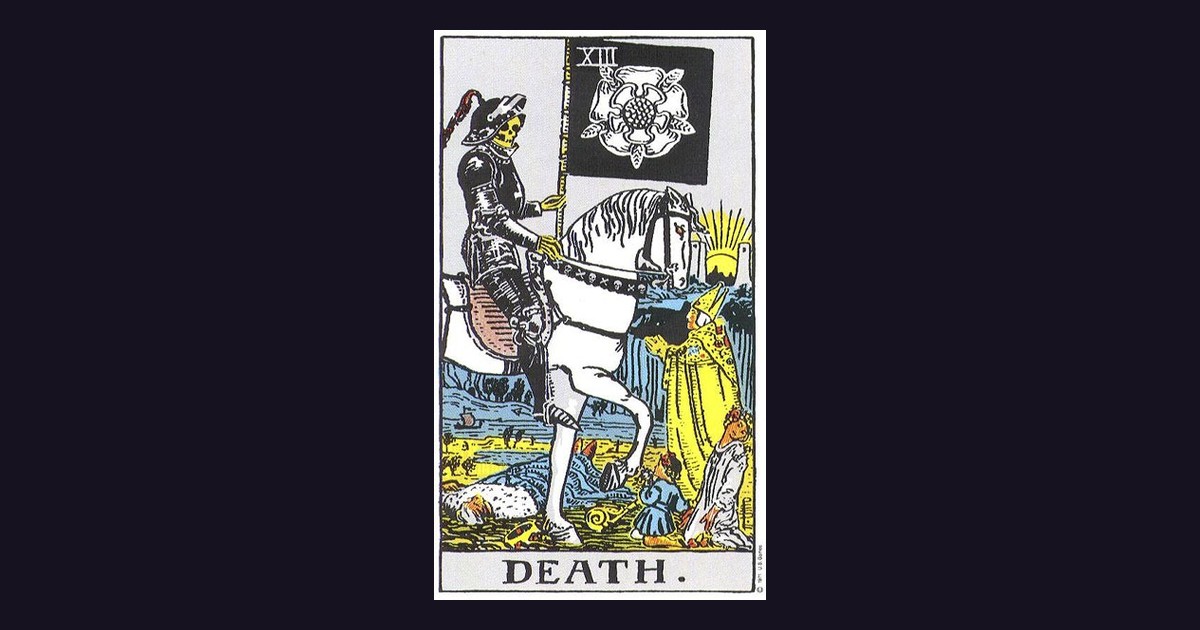
To understand the essence of this card, we must look beyond the immediate shock of its imagery. In the traditional Rider Waite Smith deck, the figure of Death arrives on a white horse, trampling over kings and peasants alike. This signifies that change is the great equalizer; no one, regardless of status or power, is exempt from the laws of impermanence.
The armor worn by the figure suggests that this transition is a necessary protection. Transformation is often a violent process internally, and the armor represents the strength required to endure the shedding process. Look closely at the background: a rising sun between two pillars. This is the most critical detail of the card. It signals that while the foreground is filled with endings, the horizon is glowing with a new dawn. The sun represents hope, rebirth, and the inevitable arrival of a new cycle.
The presence of the river in the background symbolizes the flow of time and the crossing from one state of being to another. It reminds us that we are not static beings, but fluid entities in a constant state of becoming. When this card appears, the universe is not telling you that something is being taken away, but rather that something is being cleared away to create a vacuum that a higher vibration can fill.
The Spiritual Psychology of Letting Go
Most of our fear regarding the Death card stems from our attachment to the known. Human psychology is wired to crave stability, even when that stability is toxic or stagnant. We often cling to a dying job, a faded romance, or an outdated belief system because the void of the unknown feels more terrifying than the misery of the familiar.
The Death card asks us to examine our attachments. What are you holding onto so tightly that your knuckles have turned white? When this card appears, it suggests that the energy you are spending to maintain a dying situation is energy that could be used to build something new. Spiritually, this is the process of alchemy. To turn lead into gold, the lead must first be broken down.
In a reading, Death represents the point of no return. It is the moment when the bridge has burned, and the only way forward is through the transformation. While this can feel like a loss, it is actually a liberation. When we stop fighting the inevitable, we stop suffering. The pain of the Death card is not the pain of loss, but the pain of growth.
Death in Different Reading Contexts
Depending on where the card falls in a spread, its nuance shifts, though its core message of transition remains constant.
In Love and Relationships
When Death appears in a love reading, it rarely means the literal end of a partnership, though it can. More often, it signifies the death of a specific dynamic. Perhaps the honeymoon phase has ended, and the relationship must evolve from superficial passion into deep, grounded commitment. Or, perhaps a pattern of codependency must die so that two independent souls can meet as equals.
If the relationship does end, the card suggests that the conclusion is a mercy. It indicates that the connection has served its karmic purpose and that staying together would only stifle the growth of both parties. In this context, the card encourages a graceful exit, urging you to honor what was while accepting that the chapter is closed.
In Career and Ambition
In a professional context, Death often manifests as a sudden layoff, a desire to change industries, or the realization that your current path no longer aligns with your soul’s purpose. It is the card of the career pivot. It suggests that you have reached a plateau where there is nothing left to learn in your current role.
If you are feeling stuck, the Death card is a green light to walk away. It encourages you to stop trying to fix a broken system and instead start building a new one. It is a call to stop playing a role that is too small for you.
In Spiritual Growth and Internal Work
On a spiritual level, Death is one of the most positive cards in the deck. It represents an awakening. It is the shedding of the ego, the dismantling of the false self, and the collapse of the masks we wear to please others. This is the dark night of the soul, where we face our shadows and decide who we want to be once the old structures have fallen. It is the ultimate card of spiritual maturity.
Practical Rituals for Navigating Transition
Knowing the meaning of the card is one thing; living through the transition is another. When the energy of the Death card is active in your life, you need practical tools to manage the emotional weight of the process.
The Ritual of the Burning List
To help move through the energy of shedding, perform a conscious release ritual. Take a piece of paper and write down everything you are ready to let go of. Be specific. Write down the resentment you hold toward a parent, the shame you feel about a past failure, or the habit that keeps you small.
Fold the paper and burn it in a safe container, visualizing the smoke carrying these old energies away into the ether. As the paper turns to ash, say aloud: I release what no longer serves my highest good to make space for what does. This physical act signals to your subconscious that the ending is intentional and sacred.
The Space Clearing Practice
Since the Death card is about clearing the old to make room for the new, your physical environment should reflect this. Spend a weekend decluttering your living space. Throw away clothes that belong to a version of you that no longer exists. Clear out the drawers of old papers and broken objects. As you clear your physical space, you are creating a psychic vacuum that invites new opportunities to enter.
Mindful Observation of Nature
To ground yourself during a period of transition, spend time observing the seasons. Walk through a forest in autumn and look at the falling leaves. The trees are not dying; they are strategically shedding their foliage to survive the winter and bloom more vibrantly in the spring. Remind yourself that you are a part of this same natural law. You are currently in your autumn, preparing for your spring.
Integrating the Lesson: Moving Toward the New Dawn
The most important thing to remember when you see the Death card is that it never appears in isolation. In a full spread, look at the cards surrounding it. If it is followed by the Ace of Wands, a burst of new passion is coming. If it is followed by the Star, healing and hope are on the horizon.
The Death card is a bridge. To get to the other side, you must be willing to step off the ledge of the known. This requires a leap of faith and a deep trust in the universe. Trust that if something is leaving your life, it is because it is no longer capable of supporting the person you are becoming.
The transition may be uncomfortable, and there may be tears, but there is a profound peace that comes with total surrender. When you stop gripping the wreckage of the past, your hands become free to receive the gifts of the future.
The journey of the soul is a series of deaths and rebirths. We die a thousand times before we leave this earth—we die as children to become adolescents, we die as dreamers to become doers, we die as victims to become victors. Embrace the skeleton on the pale horse not as a harbinger of doom, but as a guide who is simply helping you pack your bags for a better destination. You are not ending; you are evolving.
Frequently Asked Questions
Does the Death card always mean something bad is going to happen?
Not at all. While it indicates an ending, that ending is usually a necessary prerequisite for growth. It often removes obstacles or toxic influences that you were too afraid to remove yourself.
What should I do if I feel overwhelmed by the energy of this card in a reading?
Focus on the rising sun in the background of the card. Remind yourself that the transition is temporary and that the purpose of the void is to be filled with something more aligned with your true purpose.
Can the Death card be reversed? What does that mean?
Yes, and a reversed Death card often indicates resistance to change. It suggests that you are clinging to something that is already gone, which creates unnecessary suffering by delaying the inevitable transformation.
Step-by-Step Practice Protocol
The protocols below come from documented spiritual, psychological, or contemplative traditions. They support self-reflection and skill-building — not medical diagnosis, crisis care, or literal prediction of future events.
This is a standard reflective tarot session — you use the cards as symbolic prompts for honest self-inquiry, not fortune-telling.
Time needed: 15–25 minutes
- Prepare: sit at a clean surface, one question written in a journal (one sentence, present-tense). Breathe 4 counts in, 6 counts out, three times.
- Shuffle while holding the question; stop when it feels complete (often 1–3 minutes). Cut the deck once with your non-dominant hand.
- Draw the spread your article describes (or three cards: context · challenge · guidance). Place cards left to right.
- Before opening a guidebook, note first impressions: colors, figures, direction figures face, your bodily response.
- Record upright/reversed orientation, 3 keywords per card, and one sentence linking each card to your question.
- Write one concrete action for the next 48 hours inspired by the Advice theme — small and measurable.
- Close: summarize the spread in your own words; store date, question, and cards drawn for later review.
Tradition & references: Rider-Waite-Smith deck structure; reflective reading methods taught in books such as Rachel Pollack’s 78 Degrees of Wisdom and Mary K. Greer’s Tarot for Your Self.

Tarot & Symbolism Specialist
Mara Vey has read tarot and Elder Futhark runes for over a decade and writes on the psychology of symbols. She approaches divination as a tool for reflection rather than fortune-telling, grounding every reading in documented tradition.
Read Mara Vey's full profile →✦
Editorial Standards
Practices on AfterDarkIntuition are researched from depth psychology (Jung), established spiritual traditions, and contemporary therapeutic frameworks. They are for self-reflection and personal growth — not medical, psychiatric, or crisis care. If you are in crisis, please contact a licensed professional or emergency services. About our editorial approach →
Editorial Note
Written for self-reflection and spiritual exploration. Not medical or psychological advice. Our editorial standards →
Written for self-reflection and spiritual exploration. Not medical or psychological advice. Our editorial standards →