Tarot
Jun 8, 2026
·
13 min read
·
Updated Jul 20, 2026
How to Do a 3-Card Tarot Spread: Past, Present, and Future
🕯 9 min read · June 8, 2026
Editorial Note · This tarot piece was fact-checked against positional meanings and reader FAQ threads — no generic keyword stuffing.
The three-card Past–Present–Future spread is the first reading most tarot readers ever learn — and many professionals still use it daily decades later. It is fast, flexible, and forces you to think in narrative: where you have been, where you stand, and where your current path is taking you. This guide walks you through the whole process, from shuffling to interpreting difficult card combinations.
What You Need Before You Start
You need a tarot deck and about ten quiet minutes. If you are choosing your first deck, the Rider–Waite–Smith is the standard teaching deck: nearly every book, app, and course keys its meanings to RWS imagery, so learning is much faster. Beyond the deck, nothing else is required — candles, crystals, and cloths are atmosphere, not necessity.
Decide on your question before you touch the cards. Vague questions produce vague readings. Instead of “What about my job?”, ask “What do I need to understand about my current job situation?” Open-ended “what/how” questions work better than yes/no questions, because tarot describes dynamics rather than delivering verdicts.
Step-by-Step: The Reading Itself
1. Shuffle and cut
Shuffle in any way that feels natural — riffle, overhand, or spreading the cards on the table and swirling them. There is no “correct” method. While shuffling, hold your question in mind. Stop when the deck feels settled; many readers describe it as a small click of “done.” Cut the deck once with your non-dominant hand if you like the ritual of it.
2. Draw three cards, left to right
Lay them face down in a row, then turn them over one at a time:
- Card 1 — Past: the influences, decisions, or events that shaped the current situation. This is often something you already know, and its job is to confirm you are looking at the right story.
- Card 2 — Present: the heart of the reading. This card describes the energy of right now — what is actually happening, as opposed to what you fear or hope is happening.
- Card 3 — Future: the likely direction if nothing changes. Tarot’s future card is a trajectory, not a sentence. It shows where the current road leads so you can decide whether to stay on it.
3. Read the story, not just the cards
Beginners often look up three separate meanings and stop. The real skill is connecting them. Ask: how did card one lead to card two? What does card two need to do about card three? A Six of Swords in the past, a Two of Wands in the present, and The Sun in the future tells one continuous story: a difficult departure, a moment of planning, and a bright outcome ahead if the planning is followed through.
Reading the “Scary” Cards
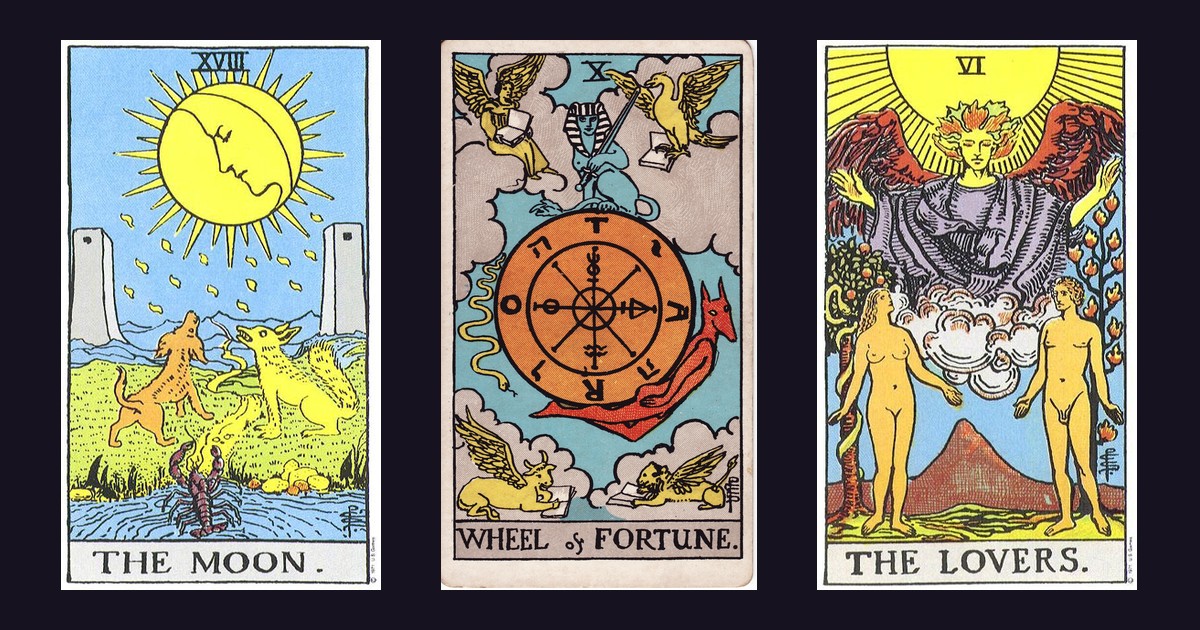
Sooner or later you will flip Death, The Tower, or the Ten of Swords in the future position and feel your stomach drop. Take a breath. In hundreds of years of tarot tradition, these cards have never meant literal doom in a general reading:
- Death marks an ending that makes room for something new — a job, a phase, an identity. It is the composting card, not the catastrophe card.
- The Tower is sudden change and the collapse of something built on shaky foundations. Uncomfortable, yes — but Tower moments are usually the ones people later call turning points.
- Ten of Swords is rock bottom, which contains its own quiet mercy: it cannot get worse from here, and the sunrise is literally on the card.
Read these cards in context of the question. Death in a career reading usually means a role ending; in a relationship reading, a dynamic ending — not the relationship itself, necessarily, but the way it has been running.
Beyond Past–Present–Future: Other Three-Card Frames
Once the mechanics feel comfortable, try re-labelling the same three positions. The layout is identical; only the questions change:
- Situation — Obstacle — Advice: the most practical everyday spread.
- Mind — Body — Spirit: a check-in spread for self-care days.
- You — The Other Person — The Relationship: for any relationship question, romantic or not.
- Option A — Option B — What You Need to Know: for decisions.
Declare the frame before you draw. The positions give the cards their grammar; changing the frame after seeing the cards is how wishful thinking sneaks into readings.
Common Beginner Mistakes
- Re-drawing until you like the answer. One question, one spread, one day. Repeat readings on the same question blur into noise.
- Reading only the keywords. Look at the image first. What is happening in the picture? Your first impression is often more useful than the booklet definition.
- Treating the future card as fixed. It is a forecast based on current conditions. You are allowed to take an umbrella.
- Reading while emotionally flooded. If you are panicking about the topic, your interpretation will be panic wearing a tarot costume. Wait a few hours.
A Worked Example
Question: “How can I improve my creative practice?” Cards drawn: Eight of Pentacles (past), Four of Cups (present), The Star (future).
The story reads cleanly: you put in serious, disciplined work (Eight of Pentacles), but lately you have gone flat — bored, uninspired, ignoring opportunities right in front of you (Four of Cups). The Star ahead promises renewed inspiration and healing, and its advice is built into the present card: the cup being offered in the Four of Cups is the thing you keep dismissing. Say yes to the invitation you have been ignoring, and the spark returns.
That is the whole craft in miniature: three cards, one story, one actionable insight. Do it daily for a month and you will know your deck better than any book can teach you.
Integrating Tarot with Mindfulness and Self-Reflection
While often seen as a tool for divination, tarot truly shines as a mirror for self-reflection. Its archetypal imagery, when approached with a mindful attitude, can illuminate internal landscapes and unconscious patterns. This is where the wisdom of depth psychology, particularly the work of Carl Jung, aligns beautifully with tarot practice.
Jung proposed that the human psyche contains a “collective unconscious,” a reservoir of universal symbols and archetypes shared across cultures. The Major Arcana of the tarot, with its figures like The Fool, The Magician, The High Priestess, and The Empress, clearly embodies many of these archetypes. When you draw a card like The Hermit, it’s not just a picture of an old man with a lamp; it can evoke your own need for introspection, solitude, or inner guidance. This recognition allows for a deeper, more personal engagement than simply memorizing keywords.
To integrate mindfulness into your tarot practice, consider these steps:
- Set an Intention: Before shuffling, take a few deep breaths. Ground yourself. State your question clearly, not just for the cards, but for your own inner awareness. What are you truly seeking to understand?
- Observe Without Judgment: As you turn over each card, resist the immediate urge to interpret or label it “good” or “bad.” Instead, simply observe the imagery. What colors stand out? What emotions does the scene evoke? What figures are present, and what are they doing? This is similar to the “noting” practice in Mindfulness-Based Stress Reduction (MBSR), where you observe thoughts or sensations without getting entangled in them.
- Connect to Your Body: How does your body react to the cards? Does a particular image cause a tightening in your chest, a sense of relief, or a feeling of unease? Our bodies often hold unconscious wisdom that can inform our understanding of the cards.
- Journal Your Insights: After a reading, dedicate time to journal. Don’t just write down the card meanings. Explore how the cards relate to your question, your current life situation, and your internal experience. What new perspectives have emerged? What feelings were stirred? This process helps integrate the insights from the reading into your conscious awareness, making them actionable.
By treating tarot as a contemplative practice, you move beyond mere prediction and engage with it as a profound tool for personal growth, bringing unconscious material into conscious light.
The Ethics of Reading for Others
Once you’re comfortable reading for yourself, friends and family might start asking for readings. This is a lovely way to share your budding skill, but it comes with a set of ethical considerations that distinguish a responsible reader from a careless one.
1. Do No Harm
This is the cardinal rule. Remember that people come to tarot often when they are vulnerable, seeking clarity or reassurance. Avoid definitive statements about fixed futures, health diagnoses, or legal outcomes. Instead of saying, “You will lose your job,” you might say, “The cards suggest a significant transition in your career, prompting you to re-evaluate your professional path.” Frame insights as possibilities, not certainties.
2. Maintain Confidentiality
What is shared in a reading stays in a reading. This is as important for a casual reading with a friend as it is for a professional session. Building trust is paramount.
3. Empower, Don’t Enable
The goal of a reading is to empower the querent to make their own informed decisions, not to make decisions for them. If a querent asks, “Should I break up with them?”, avoid a direct “yes” or “no.” Instead, guide them to explore the dynamics of the relationship as revealed by the cards, asking questions like, “What does the Ten of Swords in the ‘relationship dynamic’ position tell you about how you’re feeling right now?”
4. Be Honest About Your Limits
You are not a therapist, doctor, lawyer, or financial advisor. If a querent presents a question that clearly falls into one of these professional domains, gently suggest they seek advice from a qualified expert in that field. For instance, if someone asks about a medical condition, you might say, “I can’t offer medical advice, but the cards suggest a need for self-care and attention to your well-being. Perhaps consulting a healthcare professional would be a good next step.”
5. Avoid Reading for Third Parties Without Consent
It’s generally considered unethical to do a reading about someone who has not given their explicit consent. Focus on the querent’s relationship to that person, or their feelings about the situation, rather than trying to divine the other person’s intentions or fate.
Beyond the Books: Developing Your Intuitive Language
While guidebooks are invaluable for learning the foundational meanings of the RWS deck, true mastery comes from developing your own intuitive connection to the cards. This isn’t about ignoring established meanings but about letting them serve as a launchpad for deeper, more personal insights.
1. Engage with the Imagery
Spend time simply looking at each card. What details do you notice that aren’t mentioned in the book? Does the expression on a figure’s face speak to you? Does the landscape evoke a particular feeling? The more you engage with the visual narrative, the more the cards will start to “speak” to you directly.
2. Keep a Tarot Journal
Beyond journaling about your readings, dedicate a section of your journal to individual cards. When you draw a card, even outside of a formal spread, write down your immediate impressions, feelings, and any memories or associations it triggers. Over time, you’ll build a rich, personal database of meanings that resonate specifically with you.
3. Meditate with a Single Card
Choose one card that you find particularly challenging or compelling. Place it where you can see it and simply meditate on it for 5-10 minutes. Let its imagery, colors, and symbolism sink in. What messages emerge when you give it your undivided attention? This practice is akin to the Osho Zen Tarot’s emphasis on meditative contemplation of images to access inner wisdom.
4. Observe Card Combinations in Daily Life
Start to see the world through a “tarot lens.” When you encounter a situation, ask yourself, “Which tarot cards represent this?” For example, a difficult decision might feel like the Two of Swords; a moment of creative inspiration, the Ace of Wands. This trains your mind to connect real-world experiences with archetypal tarot energies, strengthening your intuitive understanding of how cards interact.
Developing your intuitive language with tarot is a journey, not a destination. It requires patience, practice, and a willingness to trust your inner voice, even when it diverges slightly from what the books say.

Tarot & Symbolism Specialist
Mara Vey has read tarot and Elder Futhark runes for over a decade and writes on the psychology of symbols. She approaches divination as a tool for reflection rather than fortune-telling, grounding every reading in documented tradition.
Read Mara Vey's full profile →✦
Editorial Standards
Practices on AfterDarkIntuition are researched from depth psychology (Jung), established spiritual traditions, and contemporary therapeutic frameworks. They are for self-reflection and personal growth — not medical, psychiatric, or crisis care. If you are in crisis, please contact a licensed professional or emergency services. About our editorial approach →
Editorial Note
Written for self-reflection and spiritual exploration. Not medical or psychological advice. Our editorial standards →
Written for self-reflection and spiritual exploration. Not medical or psychological advice. Our editorial standards →