Tarot
Jun 8, 2026
·
11 min read
·
Updated Jul 5, 2026
Judgement Tarot Card: Awakening, Reckoning, and Second
🕯 9 min read · June 8, 2026
Editorial Note · Reviewed with our tarot editors for positional clarity — upright and reversed cues stay tied to your actual question context.
Judgement Tarot Card: Awakening, Reckoning, and Second Chances
About this guide: The sections above explain context and symbolism. The protocol below is a documented method you can practice tonight — grounded in established traditions, not invented rituals or guaranteed predictions.
Have you ever felt a sudden, inexplicable pull to change every single thing about your life? Perhaps it was a midnight epiphany, a recurring dream, or a series of synchronicity so precise that you could no longer pretend they were coincidences. This is the vibration of the Judgement card. It is the sound of the cosmic trumpet calling you out of the slumber of your old identity and inviting you to step into a higher version of yourself.
While the word judgement often triggers an immediate sense of anxiety or fear of condemnation, in the realm of the Tarot, this card is rarely about punishment. Instead, it is about the Great Awakening. It is the moment where the scales of the soul are balanced, the lessons of the past are integrated, and the door to a second chance swings wide open.
The Symbolism of the Call
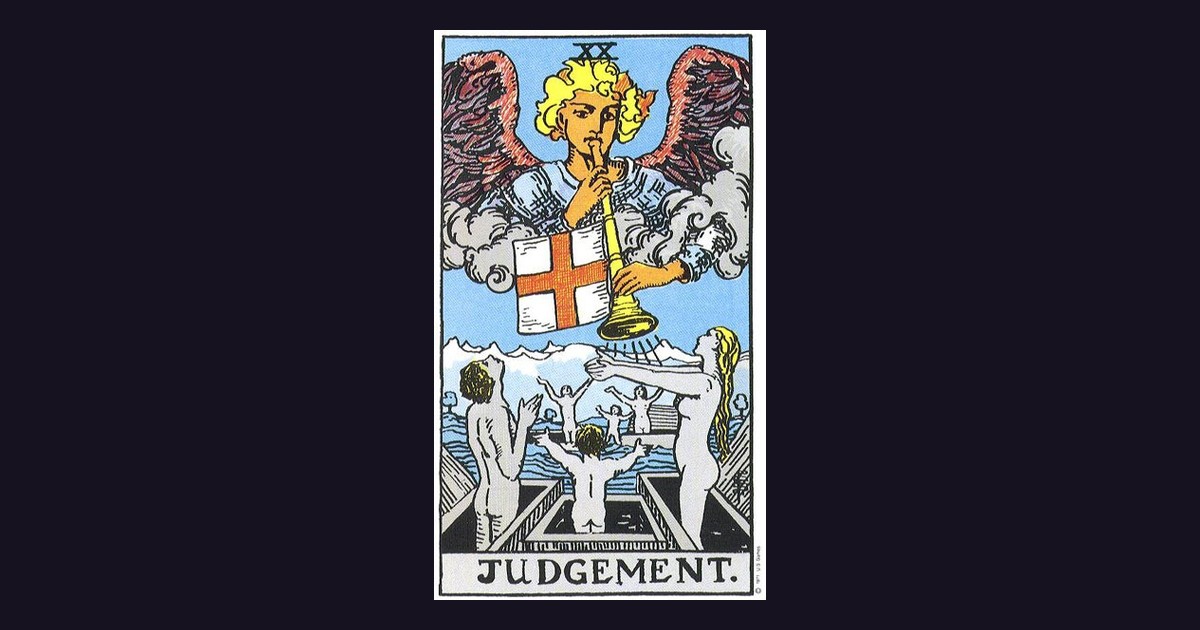
To understand Judgement, we must look at the imagery typically found in the Rider Waite Smith tradition. An angel hovers in the clouds, blowing a golden trumpet. Below, people rise from their coffins, reaching upward. This is not a scene of death in the physical sense, but a representation of spiritual resurrection.
The coffins represent the outdated beliefs, dead-end relationships, and limiting narratives we have buried ourselves in. When the trumpet sounds, it is a wake up call. It signals that the time for hiding is over. The figures rising are not being judged by an external deity as much as they are answering a call to their own higher consciousness.
The celestial nature of the card suggests that this process is supported by the universe. You are not alone in your reckoning; you are being guided by a divine frequency that knows exactly who you are meant to be. The movement is upward, indicating an elevation of perspective. You are moving from the narrow view of the ego to the panoramic view of the soul.
The Three Pillars: Awakening, Reckoning, and Second Chances
The Judgement card operates on three distinct spiritual levels. Depending on where you are in your journey, you may be experiencing one or all of these phases simultaneously.
The Awakening: The Moment of Clarity
Awakening is the sudden realization that you can no longer live the way you have been living. It is the moment the veil drops. This often manifests as a period of intense introspection where you see your life with startling objectivity.
For example, imagine someone who has spent a decade in a career they despise, convincing themselves that stability is more important than passion. The Awakening occurs when they suddenly realize that stability is actually a gilded cage. The realization is not a slow burn; it is a lightning strike. This is the Judgement card in its purest form—the sudden shift in consciousness that makes the old way of being impossible to maintain.
The Reckoning: The Honest Inventory
Once the awakening occurs, the reckoning follows. This is the process of taking an honest inventory of your life. Reckoning is not about shame; it is about accountability. It is the act of looking at your past mistakes not to dwell on them, but to extract the wisdom from them.
In a tarot reading, the reckoning phase asks: What have I learned from my failures? Where did I betray my own truth? What patterns have I repeated for years, and why? This is the heavy lifting of the Judgement card. It requires a brutal honesty that can be uncomfortable, yet it is the only way to clear the slate. Without the reckoning, the awakening is merely a fleeting emotion rather than a permanent transformation.
The Second Chance: The Resurrection
The most beautiful aspect of Judgement is the promise of the second chance. This is the resurrection. After the awakening and the reckoning, you are granted a clean slate. This is not a return to who you were before, but a birth into who you are meant to be.
A second chance in the context of Judgement often manifests as a reconciliation, a new career path, or a spiritual rebirth. It is the opportunity to apply the lessons of the past to a new beginning. If you have spent years in a cycle of toxic relationships, the second chance is the ability to enter a new partnership with the wisdom and boundaries you previously lacked. You are not just starting over; you are starting from experience.
Integrating Judgement into Your Daily Practice
Knowing the theory of a card is one thing, but embodying its energy is another. When Judgement appears in your spread, or when you feel its energy in your life, you can use specific practices to facilitate the transition.
The Ritual of the Soul Inventory
To harness the reckoning aspect of this card, perform a written soul inventory. Set aside an hour of silence and a journal. Divide a page into two columns. In the first column, list the things you are leaving behind—the habits, the resentments, and the versions of yourself that no longer serve you.
In the second column, list the qualities of the person you are becoming. Be specific. Instead of writing I want to be happy, write I am a person who speaks my truth even when my voice shakes. By naming these shifts, you are consciously answering the call of the trumpet.
The Practice of Radical Forgiveness
Because Judgement is about clearing the path for a second chance, forgiveness is essential. You cannot rise from the coffin if you are still chained to the ghosts of your past.
Try a forgiveness meditation. Visualize the person or the version of yourself that caused you pain. See them clearly and say, I release you from the debt you owe me. I reclaim my energy. By releasing the judgment of others and yourself, you stop the cycle of karmic repetition and allow the resurrection to take place.
Listening for the Divine Frequency
The trumpet is a symbol of a frequency. In modern terms, this is your intuition. To hear your own call, you must cultivate silence. Spend ten minutes a day in complete stillness, asking the question: What is calling me now? Do not look for a logical answer. Listen for the feeling in your chest or the sudden flash of an image. The call of Judgement is rarely a whisper; it is a resonance that vibrates in your soul.
Judgement in Different Reading Contexts
When this card appears in a spread, its meaning shifts slightly depending on the surrounding cards, but the core theme of transformation remains.
In a love reading, Judgement often signals a turning point. It could mean the end of a relationship that has run its course, or it could mean a profound healing between partners that allows the relationship to start anew on a higher plane of honesty.
In a career reading, it often suggests a calling. You may feel a sudden urge to switch fields or pursue a vocation that feels more aligned with your soul’s purpose. It is a sign that you are being called to contribute your unique gifts to the world.
In a spiritual reading, it is one of the most powerful cards in the deck. It suggests a spiritual initiation. You are moving from a state of unconsciousness to a state of awareness. It is a sign that you are ready to step into your power as a conscious creator of your own destiny.
Navigating the Shadow of Judgement
Every card has a shadow side. When Judgement appears in a reversed position or in a challenging aspect, it can manifest as self-criticism, denial, or the refusal to hear the call.
The shadow of Judgement is the inner critic who tells you that you are too flawed for a second chance. It is the voice that says you have made too many mistakes to ever be redeemed. When this happens, the energy of the card becomes stagnant. You remain in the coffin, staring at the lid, hearing the trumpet but refusing to wake up.
To move through this shadow, you must shift your perspective from judgment to curiosity. Instead of asking Why did I do this?, ask What was my soul trying to learn through this experience? When you move from shame to curiosity, the weight of the past lifts, and the path to awakening opens.
The Alchemy of Transformation
The Judgement card teaches us that nothing is ever truly lost. Every mistake was a lesson, every heartbreak was a pruning, and every failure was a redirection. The reckoning is not a trial to see if you are worthy; it is a process of refining your spirit until only the truth remains.
When you answer the call, you are agreeing to live authentically. You are deciding that the fear of the unknown is less than the pain of staying the same. This is the ultimate act of courage: the willingness to be seen, to be honest, and to rise.
As you move forward, remember that the trumpet sounds for everyone, but only those who are willing to leave the safety of the grave can experience the joy of the awakening. You are being called to a higher version of yourself. The door is open, the air is fresh, and the second chance is yours for the taking. Step out into the light and embrace the rebirth you have earned.
Frequently Asked Questions
Does the Judgement card mean someone is judging me?
Rarely. In most cases, this card refers to a personal internal awakening or a spiritual reckoning rather than external criticism. It is more about your own alignment with your higher self than the opinions of others.
Is Judgement a sign that a relationship is ending?
It can be, but not necessarily in a negative way. It signifies that the current dynamic has reached its conclusion, and a new phase is beginning, whether that means a breakup or a complete transformation of how you relate to each other.
How do I know if I am experiencing a Judgement moment in my life?
You will likely feel a strong sense of urgency, a feeling that you can no longer ignore your true desires, and a series of events that force you to be honest about your life. It feels like a tipping point where staying the same is more painful than changing.
Step-by-Step Practice Protocol
The protocols below come from documented spiritual, psychological, or contemplative traditions. They support self-reflection and skill-building — not medical diagnosis, crisis care, or literal prediction of future events.
This is a standard reflective tarot session — you use the cards as symbolic prompts for honest self-inquiry, not fortune-telling.
Time needed: 15–25 minutes
- Prepare: sit at a clean surface, one question written in a journal (one sentence, present-tense). Breathe 4 counts in, 6 counts out, three times.
- Shuffle while holding the question; stop when it feels complete (often 1–3 minutes). Cut the deck once with your non-dominant hand.
- Draw the spread your article describes (or three cards: context · challenge · guidance). Place cards left to right.
- Before opening a guidebook, note first impressions: colors, figures, direction figures face, your bodily response.
- Record upright/reversed orientation, 3 keywords per card, and one sentence linking each card to your question.
- Write one concrete action for the next 48 hours inspired by the Advice theme — small and measurable.
- Close: summarize the spread in your own words; store date, question, and cards drawn for later review.
Tradition & references: Rider-Waite-Smith deck structure; reflective reading methods taught in books such as Rachel Pollack’s 78 Degrees of Wisdom and Mary K. Greer’s Tarot for Your Self.

Tarot & Symbolism Specialist
Mara Vey has read tarot and Elder Futhark runes for over a decade and writes on the psychology of symbols. She approaches divination as a tool for reflection rather than fortune-telling, grounding every reading in documented tradition.
Read Mara Vey's full profile →✦
Editorial Standards
Practices on AfterDarkIntuition are researched from depth psychology (Jung), established spiritual traditions, and contemporary therapeutic frameworks. They are for self-reflection and personal growth — not medical, psychiatric, or crisis care. If you are in crisis, please contact a licensed professional or emergency services. About our editorial approach →
Editorial Note
Written for self-reflection and spiritual exploration. Not medical or psychological advice. Our editorial standards →
Written for self-reflection and spiritual exploration. Not medical or psychological advice. Our editorial standards →