Osho
Jun 8, 2026
·
11 min read
Osho on Death: Why the Master Taught That Death Is a Door
🕯 9 min read · June 8, 2026
Editorial Note · Reviewed by our editorial team for actionable steps, sourcing, and safety boundaries before going live. Focus: Osho on Death: Why.
Osho on Death: Why the Master Taught That Death Is a Door
About this guide: The sections above explain context and symbolism. The protocol below is a documented method you can practice tonight — grounded in established traditions, not invented rituals or guaranteed predictions.
What if the thing you fear most is actually the greatest gift you have ever been given? For most of us, death is the ultimate silence, the great void, the terrifying curtain that falls on the play of our lives. We spend our entire existence building walls against it, distracting ourselves with noise, or praying to a deity to delay the inevitable. But Osho, the provocative mystic and master of meditation, flipped this narrative on its head. He did not suggest that we simply accept death; he suggested that we celebrate it.
To Osho, death is not an end, but a doorway. It is the final transition from the fragmented identity of the ego to the wholeness of existence. To understand this perspective is to change the very chemistry of how you live today. When you stop viewing death as a wall and start seeing it as a door, the anxiety of existence evaporates, leaving behind a profound sense of freedom and presence.
The Great Illusion of the Ego
To understand why Osho viewed death as a door, we must first understand what he believed was actually dying. In the Osho perspective, the body dies, but the entity that we call the I does not. The problem is that we have spent our entire lives identifying with the wrong thing. We believe we are the name, the profession, the social status, and the physical vessel. This is the ego.
The ego is a collection of memories and conditioned responses. It is a mask we wear to navigate the material world. Because the ego is an illusion, it is terrified of death. To the ego, death is annihilation because the ego cannot exist without a body and a story. However, Osho taught that the real you—the consciousness, the witness—is eternal.
When the body falls away, the mask falls away. What remains is the pure, unconditioned awareness that has always been there, hidden beneath the noise of the mind. In this sense, death is not the loss of life, but the loss of the illusion. It is the moment the prisoner is finally released from the cell of the ego.
Death as the Ultimate Meditation
Osho often remarked that most people die in a state of panic because they have spent their whole lives avoiding the thought of death. They arrive at the doorway of the great transition as strangers, terrified and clinging to the wreckage of their worldly attachments.
The Master taught that the only way to die gracefully is to learn how to die while you are still alive. This is the essence of spiritual awakening. When Osho speaks of dying while living, he is not talking about morbidity or depression. He is talking about the art of letting go.
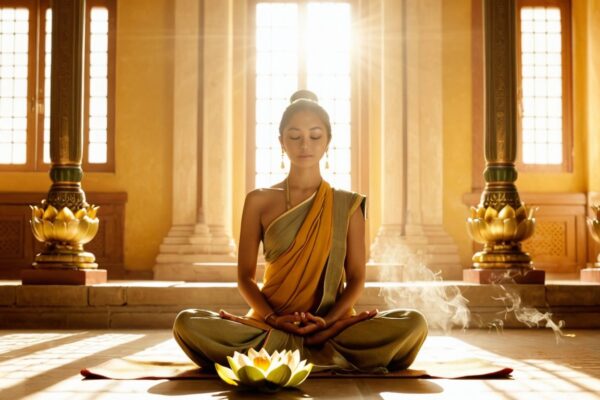
True meditation is a rehearsal for death. In deep meditation, you consciously drop your identity. For a few moments, you are no longer a father, a daughter, a CEO, or a failure. You are simply awareness. In that stillness, you experience a small taste of the void—the same void that awaits us at the end of physical life. By practicing this daily, you realize that the void is not empty in the sense of lack, but empty in the sense of being full of all possibilities.
The Doorway to the Absolute
In various spiritual traditions, death is symbolized as a crossing. In Zen, it is the crossing of the river; in Sufism, it is the annihilation of the self in the beloved. Osho synthesized these views, explaining that death is the door through which the drop merges back into the ocean.
Imagine a wave in the ocean. The wave spends its entire existence thinking it is a separate entity, fighting other waves, fearing the moment it will hit the shore and disappear. But the moment the wave crashes, it does not cease to exist; it simply realizes it was always the ocean. The wave was just a temporary form the ocean took.
This is how Osho described our transition. We are not humans having a spiritual experience; we are the Absolute taking a human form for a brief moment of play. Death is simply the moment the play ends and the actor returns to their true nature. The door is not leading to a place of judgment or a distant paradise, but back to the source of all that is.
Practical Ways to Practice Dying While Living
If death is a door, how do we prepare ourselves to walk through it with grace and joy? Theory is not enough; spiritual awakening requires practice. Here are concrete ways to integrate Osho’s teachings into your daily life to dissolve the fear of the end.
The Practice of Conscious Letting Go
Start by practicing small deaths throughout your day. Whenever you feel a strong attachment—a need to be right in an argument, a craving for validation, or a grip on a material object—consciously choose to let it go. Tell yourself: I am not this emotion. I am not this desire.
By consciously releasing these attachments, you are training your mind to let go of the biggest attachment of all: the attachment to the physical body. This creates a psychological flexibility that prevents the panic of the final transition.
The Witnessing Technique
Set aside twenty minutes a day for silent observation. Sit comfortably and simply watch your thoughts as if they are clouds passing in the sky. Do not judge them, do not fight them, and do not identify with them.
When you observe your thoughts, you create a gap between the observer and the observed. In that gap, you discover the Witness. The Witness is that part of you that does not age, does not get sick, and cannot be killed. By anchoring yourself in the Witness, you realize that while the body may be fragile, the core of your being is indestructible.
Embracing the Now
Fear of death is always a projection into the future. It is a thought about something that is not happening right now. Osho taught that the only way to conquer death is to be totally present in the moment.
When you are eating, eat totally. When you are walking, walk totally. When you are loving, love totally. When you live with total intensity, you leave nothing undone. A person who has lived fully does not fear death because they have already tasted the essence of existence. They have no pending business with the world, and therefore, they can walk through the door with a smile.
The Alchemy of Fear and Love
The fear of death and the capacity to love are two sides of the same coin. You cannot love deeply if you are terrified of loss, and you cannot overcome the fear of death unless you learn to love unconditionally.
Conditioned love is a form of possession; it says, I love you because you make me feel good. This kind of love creates fear because it depends on the presence of the other. Unconditional love, however, is a state of being. It is a fragrance that you carry.
When you love existence itself—the trees, the wind, the silence, and the chaos—you realize that you are a part of a cosmic dance. In the dance, forms change, but the dance continues. When you identify with the dance rather than the dancer, death becomes a change of costume rather than an ending.
Living with the Awareness of the End
Integrating the awareness of death into your life does not make life bleak; it makes life vivid. When you realize that your time is limited, the trivialities of life fall away. The petty grievances, the social competitions, and the endless worries about the future become absurd.
You begin to prioritize what truly matters: kindness, presence, and the expansion of consciousness. You stop living for a future that may never come and start living for the heartbeat that is happening right now. This is the paradox of Osho’s teaching: the more you accept death, the more alive you become.
The Final Transition
For those who have practiced the art of letting go, death is not a tragedy. It is the ultimate liberation. It is the moment the heavy coat of the ego is shed, and the soul steps out into the light of pure consciousness.
Imagine walking through a door after a long, exhausting journey. On the other side is not a void of nothingness, but a plenum of everything. It is the return to a home you forgot you had. The fear we feel is merely the fear of the unknown, but the unknown is where the magic happens.
By meditating, by witnessing, and by loving without possession, you turn your life into a preparation for the most beautiful event of your existence. You transform the end into a beginning. You realize that you have never been born and you can never die; you have only been dreaming that you were a separate entity.
Wake up from the dream. Walk through the door. Realize that the door was always open, and the one who was afraid was only a shadow. You are the light, and light cannot be extinguished. It can only expand, merge, and return to the infinite radiance from which it first emerged.
Frequently Asked Questions
Does this mean we should ignore the physical health of the body?
Not at all. Osho taught that we should care for the body as a temple, but we should not mistake the temple for the deity residing within. Care for your health, but do not cling to it as your primary identity.
How do I handle the grief of losing a loved one using this perspective?
Recognize that the physical form has departed, but the consciousness of your loved one has returned to the source. Grief is the ego’s reaction to loss, but love is the soul’s recognition of eternal presence.
Is this teaching similar to reincarnation?
While Osho acknowledged various traditions, he emphasized that the goal is not to keep cycling through births and deaths, but to attain enlightenment. The door of death is an opportunity to break the cycle and merge back into the Absolute.
Step-by-Step Practice Protocol
The protocols below come from documented spiritual, psychological, or contemplative traditions. They support self-reflection and skill-building — not medical diagnosis, crisis care, or literal prediction of future events.
Practice Osho active meditations exactly as staged — catharsis first, silence second. Not suitable during acute psychiatric crisis without professional guidance.
Time needed: 45–60 minutes (technique-dependent)
- Empty stomach (2+ hours after food); loose clothes; safe floor space; inform housemates if loud stages are used.
- Use official stage-timed music if available (10+10+10+15+15 for Dynamic) — timers prevent guessing.
- Stage 1–3: follow breath, expression, and movement instructions fully; do not suppress sound or shaking.
- Stage 4 (freeze/stillness): stop instantly; remain a statue; witness sensations without fixing them.
- Stage 5: gentle movement or celebration as instructed; lie down 5 minutes after if dizzy.
- Journal immediately: what released, what silence felt like, one integration action for the day. Skip driving until grounded.
Tradition & references: Published Osho International Foundation stage instructions for Dynamic, Kundalini, Nadabrahma, and related meditations; Vigyan Bhairav Tantra (translated sutras, reflective context).

Meditation & Yoga Teacher
Anil Prakash has practiced and taught meditation and pranayama for fifteen years across several traditions, from MBSR to the active methods of Osho. He writes step-by-step, evidence-aware guides and always notes contraindications and safe practice.
Read Anil Prakash's full profile →✦
Editorial Standards
Practices on AfterDarkIntuition are researched from depth psychology (Jung), established spiritual traditions, and contemporary therapeutic frameworks. They are for self-reflection and personal growth — not medical, psychiatric, or crisis care. If you are in crisis, please contact a licensed professional or emergency services. About our editorial approach →
Editorial Note
Written for self-reflection and spiritual exploration. Not medical or psychological advice. Our editorial standards →
Written for self-reflection and spiritual exploration. Not medical or psychological advice. Our editorial standards →