Tarot
Jun 8, 2026
·
11 min read
·
Updated Jul 9, 2026
The Hermit Tarot Card: A Complete Guide to Solitude and Inner Wisdom
🕯 9 min read · June 8, 2026
Editorial Note · This tarot piece was fact-checked against positional meanings and reader FAQ threads — no generic keyword stuffing.
The Hermit Tarot Card: A Complete Guide to Solitude and Inner Wisdom
About this guide: The sections above explain context and symbolism. The protocol below is a documented method you can practice tonight — grounded in established traditions, not invented rituals or guaranteed predictions.
Have you ever felt a sudden, inexplicable urge to disconnect from the noise of the world, to silence your phone, and to simply exist in the stillness of your own company? Perhaps you have reached a crossroads in your life where the advice of friends and family feels like static, and the only voice that matters is the one whispering from the deepest chambers of your own heart. This is the call of The Hermit. In the chaotic dance of the modern world, where connectivity is mandatory and silence is often mistaken for loneliness, The Hermit arrives as a sacred reminder that the most important journey you will ever take is the one that leads inward.
The Hermit is the ninth card of the Major Arcana, occupying a space of transition. He stands between the structured social order of the Hierophant and the transformative chaos of the Wheel of Fortune. He is the archetype of the seeker, the sage, and the spiritual guide who teaches us that while the world provides information, only solitude provides wisdom.
Decoding the Symbols: The Visual Language of the Sage
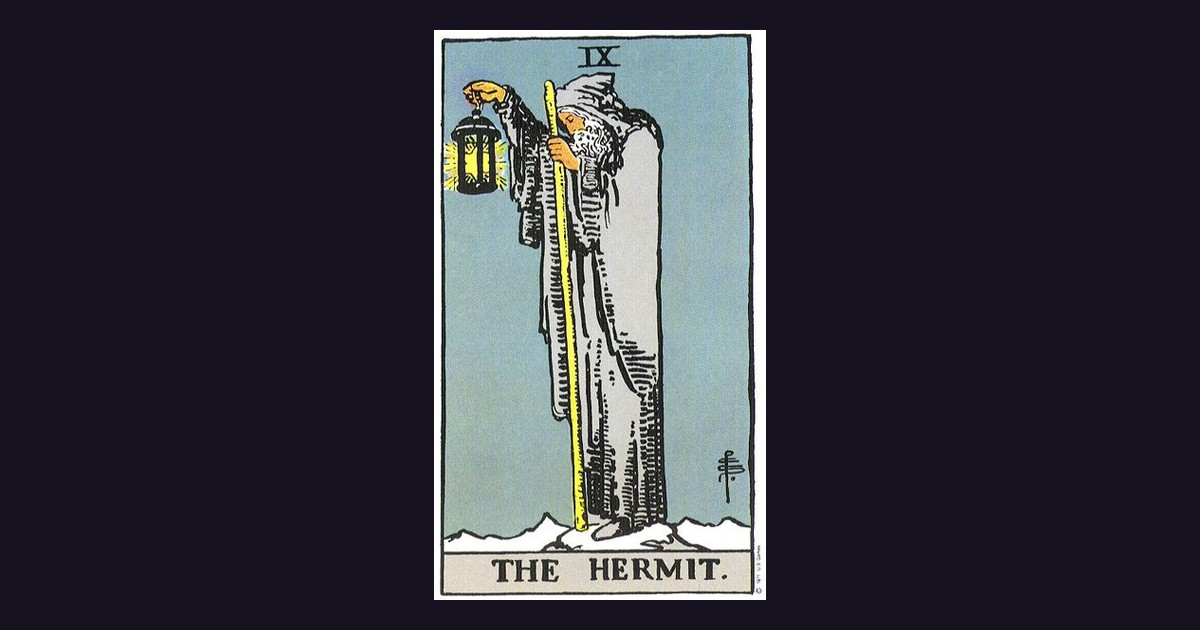
To understand The Hermit, we must look closely at the imagery found in the traditional Rider-Waite-Smith deck, as these symbols act as a map for the soul.
The Lantern of Truth
The most striking feature of The Hermit is the lantern he holds aloft. Inside this lantern is a six pointed star, representing the Seal of Solomon. This is not a light that illuminates the entire path ahead; rather, it provides just enough light for the next single step. This symbolizes the nature of spiritual growth. We are not given a map of our entire destiny; we are given enough light to take the next right action. The lantern represents the conscious mind and the divine spark that guides us through the darkness of the unknown.
The Staff of Authority
In his other hand, The Hermit holds a staff. This is not a weapon, but a tool for stability. It represents the support of experience and the grounding force of the earth. The staff reminds us that as we venture into the depths of our subconscious, we must remain rooted. It is the balance between the ethereal light of the spirit and the physical reality of the body.
The Grey Cloak and the Mountain Peak
The Hermit is draped in a grey cloak, the color of neutrality and introspection. He has stripped away the vibrant colors of social identity to embrace the simplicity of being. He stands atop a snowy mountain peak, symbolizing a high state of consciousness. He has climbed above the fray of mundane drama to gain a perspective that can only be achieved through detachment. The coldness of the mountain represents the austerity of the path; seeking truth is not always comfortable, but the view from the top is incomparable.
The Spiritual Meaning: Solitude vs. Loneliness
One of the most common misconceptions about The Hermit is that he represents isolation or loneliness. In a spiritual context, there is a profound difference between these two states. Loneliness is a feeling of lack, a void left by the absence of others. Solitude, however, is a state of fullness. It is the intentional choice to be alone so that one may encounter the True Self.
When The Hermit appears in a reading, he is calling for a period of withdrawal. This is not an invitation to hide from the world out of fear, but a summons to retreat for the purpose of integration. Imagine a seed that must spend time in the dark, damp earth before it can break through the surface and bloom. The Hermit is that period of darkness. He suggests that the answers you seek are not found in a book, a podcast, or a conversation, but in the silence that remains when all external noise is stripped away.
The Hermit in a Tarot Reading: Interpretations and Nuances
Depending on the context of a reading, The Hermit can carry different weights. Understanding these nuances allows for a more precise and empathetic divination process.
In a Career Reading
If you are asking about your professional life, The Hermit often suggests a need for a hiatus or a period of deep research. It may indicate that you are feeling burnt out by the corporate grind and need to rediscover your original purpose. It can also signal the arrival of a mentor or the need for you to become a mentor to others. It is a card of mastery, suggesting that you should stop looking for external validation and instead trust your own expertise.
In a Love and Relationship Reading
In the context of romance, The Hermit can be a challenging card because it emphasizes the individual over the couple. It may suggest a period of distance or a need for space within a relationship. However, this is often a healthy distance. It suggests that for a partnership to thrive, both individuals must be whole on their own. If you are single, The Hermit indicates a time of self-love and healing. It is a reminder that you cannot find a soulmate until you have first become a companion to yourself.
In a Spiritual Reading
This is where The Hermit is most at home. He indicates a spiritual awakening or a call to a higher calling. He suggests that you are entering a phase of introspection where you will uncover hidden truths about your lineage, your karma, or your soul’s purpose. He encourages meditation, fasting, or a pilgrimage.
Practical Applications: How to Embody the Energy of The Hermit
Knowing the theory of The Hermit is one thing; living his energy is another. If this card has appeared in your life, or if you feel the pull of the sage, here are practical ways to integrate this wisdom into your daily routine.
The Practice of Digital Fasting
The modern world is a constant stream of external input. To find the light of the lantern, you must turn off the screens. Try a digital fast for twenty four hours. Turn off your phone, avoid social media, and resist the urge to consume information. Notice the restlessness that arises. That restlessness is the ego fighting for attention. When you move past that agitation, you will find a profound stillness where your own intuition begins to speak.
The Sacred Walk
The Hermit is a wanderer. To connect with this energy, engage in a mindful walk in nature. Walk slowly, without music or a destination. Focus on the sensation of your feet hitting the ground and the rhythm of your breath. As you walk, ask a specific question of your inner self. Do not force the answer; simply hold the question in your mind and let the silence provide the response.
The Journal of Shadows
The Hermit encourages us to look at the parts of ourselves we usually ignore. Start a shadow work journal. Instead of writing about your day, write about your contradictions. Ask yourself: What am I afraid to admit about myself? Where am I performing for others? What would I do if no one was watching? By documenting these inner landscapes, you are acting as your own guide, lighting the way through your own darkness.
The Shadow Side: When the Hermit Becomes the Recluse
Every card has a shadow side, and for The Hermit, the shadow is the Recluse. There is a fine line between healthy solitude and pathological isolation.
When The Hermit’s energy is distorted, it manifests as social anxiety, bitterness, or an arrogant belief that one is superior to others because of their spiritual knowledge. The Recluse uses solitude as a shield to avoid the vulnerability of human connection. If you find yourself withdrawing not to heal, but to hide, the energy of The Hermit has turned sour. The goal of the Hermit is to eventually return from the mountain with a lantern to help others. If you stay on the mountain forever, the wisdom becomes stagnant.
Integrating the Wisdom
The Hermit teaches us that the most courageous act we can perform is to stand alone in our own truth. He reminds us that there is a sacred power in the pause. In a culture that prizes speed and productivity, choosing to slow down and look inward is a revolutionary act.
By embracing the spirit of The Hermit, you learn that you are never truly alone. Once you become comfortable in your own company, you discover that you are inhabited by the wisdom of the ages, the guidance of your ancestors, and the clarity of your own divine intuition. You realize that the lantern you have been searching for in others has been in your hand all along.
As you move forward, remember that the path of the seeker is not a straight line. There will be moments of profound clarity followed by periods of confusion. This is the nature of the journey. Trust the light of your lantern, trust the stability of your staff, and have the courage to walk into the silence. The wisdom you find there is the only thing that can never be taken away from you.
Frequently Asked Questions
Does The Hermit always mean I should spend time alone?
Not necessarily. While it emphasizes solitude, it can also mean you need to set stronger boundaries or find a quiet space within a busy life. It is more about the internal state of introspection than the physical act of being alone.
What does it mean if The Hermit appears in a reversed position?
A reversed Hermit often suggests loneliness, isolation, or a refusal to hear the truth. It can indicate that you are ignoring your intuition or that you have spent too much time in your head and need to reintegrate into the social world.
Can The Hermit represent a specific person in my life?
Yes, he often represents a mentor, a teacher, or an older, wiser individual who provides guidance. It can be a literal person, or it can represent the Wise Old Man or Wise Old Woman archetype living within your own psyche.
Step-by-Step Practice Protocol
The protocols below come from documented spiritual, psychological, or contemplative traditions. They support self-reflection and skill-building — not medical diagnosis, crisis care, or literal prediction of future events.
This is a standard reflective tarot session — you use the cards as symbolic prompts for honest self-inquiry, not fortune-telling.
Time needed: 15–25 minutes
- Prepare: sit at a clean surface, one question written in a journal (one sentence, present-tense). Breathe 4 counts in, 6 counts out, three times.
- Shuffle while holding the question; stop when it feels complete (often 1–3 minutes). Cut the deck once with your non-dominant hand.
- Draw the spread your article describes (or three cards: context · challenge · guidance). Place cards left to right.
- Before opening a guidebook, note first impressions: colors, figures, direction figures face, your bodily response.
- Record upright/reversed orientation, 3 keywords per card, and one sentence linking each card to your question.
- Write one concrete action for the next 48 hours inspired by the Advice theme — small and measurable.
- Close: summarize the spread in your own words; store date, question, and cards drawn for later review.
Tradition & references: Rider-Waite-Smith deck structure; reflective reading methods taught in books such as Rachel Pollack’s 78 Degrees of Wisdom and Mary K. Greer’s Tarot for Your Self.

Tarot & Symbolism Specialist
Mara Vey has read tarot and Elder Futhark runes for over a decade and writes on the psychology of symbols. She approaches divination as a tool for reflection rather than fortune-telling, grounding every reading in documented tradition.
Read Mara Vey's full profile →✦
Editorial Standards
Practices on AfterDarkIntuition are researched from depth psychology (Jung), established spiritual traditions, and contemporary therapeutic frameworks. They are for self-reflection and personal growth — not medical, psychiatric, or crisis care. If you are in crisis, please contact a licensed professional or emergency services. About our editorial approach →
Editorial Note
Written for self-reflection and spiritual exploration. Not medical or psychological advice. Our editorial standards →
Written for self-reflection and spiritual exploration. Not medical or psychological advice. Our editorial standards →