Tarot
Jun 8, 2026
·
12 min read
The Major Arcana Explained: All 22 Cards and Their Meanings
🕯 10 min read · June 8, 2026
Editorial Note · Reviewed with our tarot editors for positional clarity — upright and reversed cues stay tied to your actual question context.
The Major Arcana Explained: All 22 Cards and Their Meanings
About this guide: The sections above explain context and symbolism. The protocol below is a documented method you can practice tonight — grounded in established traditions, not invented rituals or guaranteed predictions.
Have you ever felt that your life is moving through invisible chapters, each one designed to teach you a lesson you didn’t know you needed? There is a profound sense of destiny in the way our challenges arrive, often mirroring a universal pattern of growth, collapse, and rebirth. This is the essence of the Major Arcana. In the world of tarot, these twenty two cards are not merely predictors of the future; they are a mirror of the human soul’s journey from innocence to enlightenment.
When you pull a Major Arcana card during a reading, the universe is shifting the conversation from the mundane details of daily life to the overarching themes of your spiritual evolution. While the Minor Arcana deals with the noise of the world—your finances, your arguments, your fleeting emotions—the Major Arcana speaks to the signal. It addresses the karmic lessons, the sudden shifts in consciousness, and the archetypal forces that shape our destiny.
Understanding the Fool’s Journey
To truly grasp the Major Arcana, you must view them as a narrative known as the Fool’s Journey. Imagine the Fool as the protagonist of a story. He begins as a blank slate, wide eyed and naive, stepping off a cliff into the unknown. As he progresses through the cards, he encounters mentors, faces his fears, undergoes ego deaths, and eventually reaches a state of wholeness.
When you study these cards, do not treat them as a vocabulary list to be memorized. Instead, treat them as a map. When a card appears in your spread, ask yourself: Where is the seeker in this story? Are they still learning the rules of the world, or are they ready to burn the old structures down to build something new?
The 22 Cards: Meanings and Archetypes
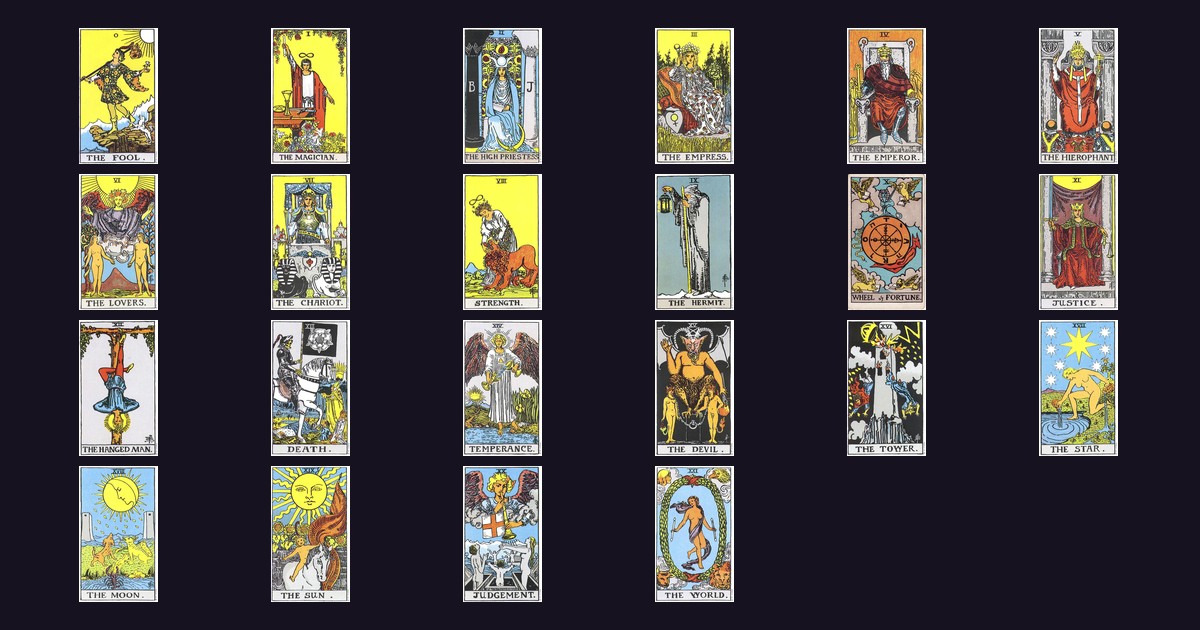
0. The Fool
The Fool represents the leap of faith. He is the spark of pure potential. When this card appears, it is an invitation to begin again with a heart full of wonder. It suggests a time of spontaneity and innocence, reminding you that sometimes the most rational thing you can do is take a risk.
1. The Magician
The Magician is the bridge between heaven and earth. With all four suits of the Minor Arcana on his table, he possesses every tool necessary to manifest his will. This card is about agency and resourcefulness. It tells you that you already have everything you need to create the reality you desire.
2. The High Priestess
While the Magician is active, the High Priestess is receptive. She sits at the veil between the conscious and subconscious minds. This card calls for silence, intuition, and the ability to listen to the whispers of your inner voice. It is a reminder that not all answers are found in logic; some are felt in the stillness.
3. The Empress
The Empress is the archetype of the Great Mother. She represents abundance, fertility, and the nurturing power of nature. This card appears when it is time to create, whether that means birthing a child, starting a business, or simply practicing radical self care. She reminds us that growth requires patience and tenderness.
4. The Emperor
Where the Empress is the heart, the Emperor is the head. He represents structure, authority, and the necessity of boundaries. This card encourages you to bring order to the chaos. It is about leadership and the ability to build a stable foundation upon which a life can be successfully constructed.
5. The Hierophant
The Hierophant represents tradition, formal education, and spiritual lineage. He is the keeper of the keys. This card often appears when you are seeking a mentor or when you are questioning the societal structures you were raised with. It asks whether you are following a path because it is right, or simply because it is the way things have always been done.
6. The Lovers
Beyond romance, The Lovers is a card of alignment and choice. It represents the moment we must decide who we are and what we value. It is about the harmony of opposites and the courage to make a choice based on love rather than fear.
7. The Chariot
The Chariot is the victory of will over instinct. It depicts a driver controlling two opposing horses, symbolizing the struggle to balance conflicting desires. This card indicates a period of intense focus and determination. It tells you that through discipline, you can steer your life in the direction you desire.
8. Strength
Strength is not about physical power, but about the courage of the heart. The image of a woman gently closing a lion’s mouth symbolizes the mastery of our primal urges through compassion. This card appears when you need to face a challenge with grace and patience rather than force.
9. The Hermit
The Hermit is the call to retreat. He carries a lantern to light his own way, symbolizing the search for inner truth. This is a period of introspection and solitude. The Hermit teaches us that the only way to find the truth is to walk the path alone for a while, away from the noise of others.
10. Wheel of Fortune
The Wheel reminds us that life is cyclical. What goes up must come down, and what is lost will eventually be found. This card represents the unpredictable nature of fate. It encourages you to remain centered while the wheel spins, knowing that no state of being is permanent.
11. Justice
Justice is the law of cause and effect. It is the reminder that every action has a reaction. This card represents fairness, truth, and accountability. It asks you to look at your situation objectively and accept the consequences of your choices with dignity.
12. The Hanged Man
The Hanged Man is the art of surrender. By hanging upside down, he sees the world from a different perspective. This card indicates a period of suspension or waiting. It teaches that sometimes the only way to move forward is to stop fighting and let go of control.
13. Death
Contrary to popular belief, Death rarely signifies physical passing. Instead, it represents the end of a cycle. It is the clearing of the old ground to make room for new growth. It is a card of profound transformation and the necessary pain of letting go.
14. Temperance
Temperance is the alchemy of balance. It is the act of mixing two opposites to create something new and harmonious. This card calls for moderation and patience. It suggests that the solution to your problem lies in finding the middle ground.
15. The Devil
The Devil represents the chains we forge for ourselves. These are the addictions, limiting beliefs, and toxic patterns that keep us trapped. The key is often hanging around the figure’s neck, symbolizing that the power to break free has been within us all along.
16. The Tower
The Tower is the most feared card, but it is often the most liberating. It represents the sudden collapse of a structure built on a false foundation. When the Tower falls, it is a violent but necessary awakening. It clears the rubble so that something authentic can be built in its place.
17. The Star
The Star is the breath of fresh air after the storm of the Tower. It represents hope, healing, and spiritual renewal. It is a promise that the universe is supporting you and that your faith will be rewarded. It is the light that guides you home.
18. The Moon
The Moon is the realm of the subconscious and the illusory. It is the time of shadows, anxiety, and confusion. This card warns that things are not as they seem. It encourages you to trust your intuition over your eyes and to navigate the darkness with caution.
19. The Sun
The Sun is the ultimate card of joy, success, and vitality. It represents clarity and the feeling of being fully seen and loved. When the Sun appears, the shadows are gone, and the truth is revealed in its brightest light. It is a celebration of existence.
20. Judgement
Judgement is the awakening. It is the moment of reckoning where you evaluate your past and decide who you want to be moving forward. It is a call to rise up and step into a higher version of yourself, leaving the ghosts of the past behind.
21. The World
The World is the completion of the journey. It represents integration, wholeness, and the achievement of a goal. It is the moment of realization where all the lessons of the previous twenty one cards come together. You have arrived.
Putting the Major Arcana into Practice
Understanding the meanings is only the first step. To truly integrate these archetypes into your spiritual practice, you must move from theory to experience.
Try a Single Card Meditation. Each morning, draw one Major Arcana card. Instead of looking up the meaning, spend five minutes staring at the imagery. Ask yourself: Which character in this card am I today? If you draw the Hermit, perhaps you need a few moments of silence during your lunch break. If you draw the Tower, perhaps you should examine which area of your life feels unstable and embrace the change.
Another practical exercise is the Archetype Mapping. If you are facing a difficult decision, draw three cards. The first represents the energy you are currently embodying, the second represents the obstacle you are facing, and the third represents the archetype you need to adopt to resolve the situation. For example, if you are feeling overwhelmed (The Tower) and facing a lack of direction (The Moon), and you draw the Emperor as the solution, the universe is telling you to implement structure and boundaries to regain your footing.
Embracing the Cycle of Growth
The Major Arcana teaches us that struggle is not a sign of failure, but a requirement for growth. We cannot reach the joy of The Sun without first enduring the darkness of The Moon; we cannot experience the peace of The World without the shedding of Death. By studying these cards, you are not just learning a divination tool; you are learning the rhythm of your own soul.
As you continue your journey with the tarot, remember that the cards do not dictate your fate—they illuminate your path. You are the author of your story, and the Major Arcana are simply the ink and parchment. May you move through your own Fool’s Journey with courage, curiosity, and an open heart, knowing that every card, no matter how challenging, is a stepping stone toward your own awakening.
Frequently Asked Questions
Do I need to memorize all the meanings to do a good reading?
No, memorization is less important than intuition. Use the guidebook as a starting point, but pay attention to how the imagery speaks to you and the specific context of the question being asked.
What does it mean if I pull mostly Major Arcana cards in a reading?
This suggests that the situation is of great spiritual significance. It indicates that the forces at play are larger than your immediate control and that a major life lesson or karmic shift is occurring.
Is The Death card always a bad sign?
Absolutely not. In most cases, Death is a positive card of renewal. It signifies the end of a stagnant period and the birth of something better, making it a card of hope and liberation.
Step-by-Step Practice Protocol
The protocols below come from documented spiritual, psychological, or contemplative traditions. They support self-reflection and skill-building — not medical diagnosis, crisis care, or literal prediction of future events.
This is a standard reflective tarot session — you use the cards as symbolic prompts for honest self-inquiry, not fortune-telling.
Time needed: 15–25 minutes
- Prepare: sit at a clean surface, one question written in a journal (one sentence, present-tense). Breathe 4 counts in, 6 counts out, three times.
- Shuffle while holding the question; stop when it feels complete (often 1–3 minutes). Cut the deck once with your non-dominant hand.
- Draw the spread your article describes (or three cards: context · challenge · guidance). Place cards left to right.
- Before opening a guidebook, note first impressions: colors, figures, direction figures face, your bodily response.
- Record upright/reversed orientation, 3 keywords per card, and one sentence linking each card to your question.
- Write one concrete action for the next 48 hours inspired by the Advice theme — small and measurable.
- Close: summarize the spread in your own words; store date, question, and cards drawn for later review.
Tradition & references: Rider-Waite-Smith deck structure; reflective reading methods taught in books such as Rachel Pollack’s 78 Degrees of Wisdom and Mary K. Greer’s Tarot for Your Self.

Tarot & Symbolism Specialist
Mara Vey has read tarot and Elder Futhark runes for over a decade and writes on the psychology of symbols. She approaches divination as a tool for reflection rather than fortune-telling, grounding every reading in documented tradition.
Read Mara Vey's full profile →✦
Editorial Standards
Practices on AfterDarkIntuition are researched from depth psychology (Jung), established spiritual traditions, and contemporary therapeutic frameworks. They are for self-reflection and personal growth — not medical, psychiatric, or crisis care. If you are in crisis, please contact a licensed professional or emergency services. About our editorial approach →
Editorial Note
Written for self-reflection and spiritual exploration. Not medical or psychological advice. Our editorial standards →
Written for self-reflection and spiritual exploration. Not medical or psychological advice. Our editorial standards →