Tarot
Jun 8, 2026
·
12 min read
·
Updated Jul 9, 2026
The Moon Tarot Card: Navigating Illusion, Fear, and the Subconscious
🕯 9 min read · June 8, 2026
Editorial Note · This tarot piece was fact-checked against positional meanings and reader FAQ threads — no generic keyword stuffing.
The Moon Tarot Card: Navigating Illusion, Fear, and the Subconscious
About this guide: The sections above explain context and symbolism. The protocol below is a documented method you can practice tonight — grounded in established traditions, not invented rituals or guaranteed predictions.
Have you ever walked through a forest at midnight, where the familiar shapes of oak and pine suddenly transformed into looming monsters or ghostly figures? In that shimmering, silver light, your eyes tell you one thing, but your intuition whispers another. This is the essence of The Moon. It is the card of the twilight zone, the space where the boundary between the waking world and the dream world dissolves, leaving us to navigate by feeling rather than sight.
When The Moon appears in a tarot spread, it rarely brings a simple yes or no. Instead, it asks a deeper question: What are you refusing to see? It is the invitation to step away from the harsh, revealing light of the sun and enter the velvet darkness of the psyche, where our deepest fears and highest intuitions coexist.
The Symbology of the Lunar Landscape
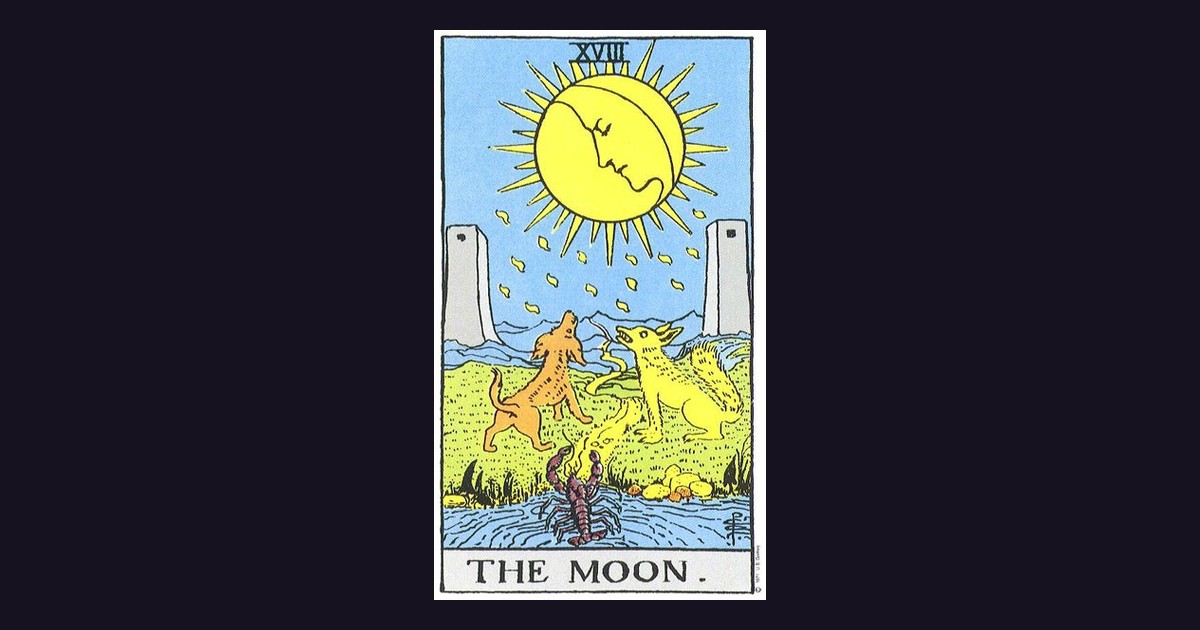
To understand The Moon, we must first look at the imagery traditionally found in the Rider Waite Smith deck. The scene is a liminal space, a threshold between the wild and the civilized.
The two towers stand as gateways, marking the entrance to the subconscious. They represent the pillars of our conscious mind, but beyond them lies a path that winds into the unknown. This path is not straight; it is meandering and uncertain, reflecting the journey of the soul through the depths of the unconscious.
Between these towers, we see a dog and a wolf. These animals represent the duality of our nature. The dog is the domestic, tamed side of our psyche—our social conditioning and learned behaviors. The wolf is the wild, primal instinct—the raw, untamed power of the subconscious. When both are howling at the moon, it suggests a tension between our civilized selves and our primal urges.
Then there is the crayfish, emerging from the dark waters. Water in tarot almost always represents the emotional realm. The crayfish represents the things that bubble up from the depths—the repressed memories, the ancestral traumas, and the hidden desires that crawl out of the murky depths of the mind to be acknowledged.
Above it all hangs the moon itself, not as a steady light, but as a shifting orb. The moon does not create its own light; it reflects the sun. This is the core of the card’s meaning: things are not as they seem. We are seeing a reflection, a distortion, or a projection.
The Psychological Weight of Illusion and Fear
In a reading, The Moon often signals a period of confusion or anxiety. This is not necessarily a warning of external danger, but rather an internal disorientation. It is the feeling of being gaslit by your own mind or feeling that something is off, even if you cannot put your finger on what it is.
Illusion in the context of The Moon is not always a lie; sometimes, it is a veil. We often create these veils to protect ourselves from truths we are not yet ready to face. For example, you might tell yourself that you are staying in a job for the sake of stability, while the subterranean current of The Moon reveals that you are actually staying out of a paralyzing fear of failure.
Fear, under the influence of The Moon, is often projection. We project our inner shadows onto other people. If you find yourself suddenly distrusting a partner or feeling an irrational sense of dread about a new project, The Moon suggests that these feelings may not be based on objective reality, but on old wounds surfacing from your subconscious. The card asks you to distinguish between a genuine intuition—a gut feeling that warns you of danger—and an anxiety-driven projection that keeps you trapped in a loop of fear.
The Call of the Subconscious
While The Moon can feel unsettling, it is one of the most spiritually potent cards in the Major Arcana. It is the card of the mystic, the psychic, and the dreamer. While the Sun represents clarity and truth, The Moon represents the deeper, occult truths that can only be found in the silence of the night.
The subconscious is the reservoir of everything we have forgotten, ignored, or suppressed. When The Moon appears, it is an invitation to dive into these waters. This is the realm of dreams, synchronicities, and the intuitive hits that arrive as flashes of insight. If you have been ignoring your dreams or dismissing your gut feelings as mere imagination, The Moon is telling you that your imagination is currently your most valuable tool for navigation.
This card marks the phase of the journey where logic fails. You cannot think your way out of a Moon phase. You cannot use a spreadsheet to solve an emotional crisis or a logical argument to heal a childhood wound. Instead, you must learn to trust your internal compass, moving forward one tentative step at a time, trusting that the path will reveal itself as you walk.
Practical Rituals for Navigating the Moon Phase
When this card dominates your energy or appears in a reading, it is time to stop fighting the fog and instead learn how to move through it. Here are three practical ways to integrate the energy of The Moon into your life.
Shadow Work and Journaling
The Moon is the ultimate card for shadow work. Shadow work is the practice of exploring the parts of yourself that you have deemed unacceptable or shameful. To do this, set aside a quiet hour during a waning moon. Light a single candle to create a soft, lunar atmosphere.
Ask yourself the following prompts and write without censoring your thoughts:
What am I most afraid of people discovering about me?
What recurring pattern in my life feels like a loop I cannot escape?
If my current anxiety were a character or a creature, what would it look like, and what is it trying to tell me?
By naming the fear, you bring it from the subconscious (where it has power over you) into the conscious mind (where you have power over it).
Active Imagination and Dreaming
Since The Moon governs the dream state, use this time to communicate with your inner self. Keep a dream journal by your bed. The moment you wake, record every fragment, no matter how nonsensical. Over time, you will notice symbols that repeat.
If you struggle with nightmares or vivid anxiety dreams, try a technique called active imagination. Before falling asleep, visualize yourself standing at the two towers seen on the card. Imagine yourself walking the path into the forest. If a shadow appears, do not run. Instead, ask it, Who are you, and what do you want from me? This turns a frightening experience into a dialogue with the soul.
Somatic Grounding
Because The Moon can make us feel ungrounded or dissociated, it is essential to return to the body. When the fog of illusion becomes too thick, use the 5-4-3-2-1 grounding technique to anchor yourself in the present moment.
Identify five things you can see, four things you can touch, three things you can hear, two things you can smell, and one thing you can taste. This pulls your awareness out of the lunar projections of the mind and back into the physical reality of the body, providing a stable platform from which you can then safely explore your intuition.
Distinguishing Intuition from Anxiety
One of the greatest challenges of The Moon is knowing the difference between a psychic warning and a panic attack. Both feel like a tightening in the chest or a sense of apprehension.
Intuition is usually a quiet, steady, and neutral signal. It feels like a knowing. It says, This is not the right path, without adding a layer of drama or catastrophe. Intuition is a compass.
Anxiety is loud, frantic, and emotional. It is accompanied by a racing heart, looping thoughts, and a sense of urgency. Anxiety says, Everything is going wrong and everyone is judging you. Anxiety is a storm.
When The Moon appears, practice pausing. When you feel a surge of emotion, ask: Is this a signal from my intuition, or is this a ghost from my past? If the feeling is accompanied by a story about what might happen in the future, it is likely anxiety. If the feeling is a simple, wordless sense of truth, it is likely intuition.
Embracing the Mystery
The Moon reminds us that not everything needs to be understood immediately. We live in a culture obsessed with transparency, data, and instant answers. We want to know exactly where we stand and where we are going. But the soul does not operate on a linear timeline.
There is a profound beauty in the mystery. There is growth that only happens in the dark, like a seed beneath the soil or a fetus in the womb. The Moon teaches us that the period of confusion is not a detour; it is the destination. It is the necessary alchemy of the soul, where our fears are melted down and transformed into wisdom.
When you stop fighting the darkness, you realize that the moonlight does not blind you—it simply asks you to look closer. It asks you to stop relying on your eyes and start relying on your heart.
As you move through this lunar phase of your life, remember that the moon always changes. The darkness is not permanent. The fog will eventually lift, and the sun will rise. But you will emerge from the forest not as the person who entered, but as someone who knows how to walk in the dark without fear. You are learning that the shadows are not enemies, but guides leading you back to your most authentic self. Trust the process, honor your depths, and allow the mystery to unfold in its own divine time.
Frequently Asked Questions
Does The Moon card always mean that someone is lying to me?
Not necessarily. While it can indicate deception or hidden information, it more often refers to self-deception or a lack of clarity. It suggests that you do not have all the facts yet, so it is best to wait before making major decisions.
Is The Moon a negative card in a reading?
No card is purely negative. While it represents fear and confusion, it also represents spiritual awakening and psychic growth. It is a card of transition that prepares you for the clarity of The Sun.
What should I do if I pull The Moon in a love reading?
This suggests a period of uncertainty or hidden emotions in the relationship. It is a call to have honest conversations and to look at whether you are projecting your own insecurities onto your partner.
Step-by-Step Practice Protocol
The protocols below come from documented spiritual, psychological, or contemplative traditions. They support self-reflection and skill-building — not medical diagnosis, crisis care, or literal prediction of future events.
This is a standard reflective tarot session — you use the cards as symbolic prompts for honest self-inquiry, not fortune-telling.
Time needed: 15–25 minutes
- Prepare: sit at a clean surface, one question written in a journal (one sentence, present-tense). Breathe 4 counts in, 6 counts out, three times.
- Shuffle while holding the question; stop when it feels complete (often 1–3 minutes). Cut the deck once with your non-dominant hand.
- Draw the spread your article describes (or three cards: context · challenge · guidance). Place cards left to right.
- Before opening a guidebook, note first impressions: colors, figures, direction figures face, your bodily response.
- Record upright/reversed orientation, 3 keywords per card, and one sentence linking each card to your question.
- Write one concrete action for the next 48 hours inspired by the Advice theme — small and measurable.
- Close: summarize the spread in your own words; store date, question, and cards drawn for later review.
Tradition & references: Rider-Waite-Smith deck structure; reflective reading methods taught in books such as Rachel Pollack’s 78 Degrees of Wisdom and Mary K. Greer’s Tarot for Your Self.

Tarot & Symbolism Specialist
Mara Vey has read tarot and Elder Futhark runes for over a decade and writes on the psychology of symbols. She approaches divination as a tool for reflection rather than fortune-telling, grounding every reading in documented tradition.
Read Mara Vey's full profile →✦
Editorial Standards
Practices on AfterDarkIntuition are researched from depth psychology (Jung), established spiritual traditions, and contemporary therapeutic frameworks. They are for self-reflection and personal growth — not medical, psychiatric, or crisis care. If you are in crisis, please contact a licensed professional or emergency services. About our editorial approach →
Editorial Note
Written for self-reflection and spiritual exploration. Not medical or psychological advice. Our editorial standards →
Written for self-reflection and spiritual exploration. Not medical or psychological advice. Our editorial standards →