Osho
Jun 8, 2026
·
11 min read
·
Updated Jul 20, 2026
Vipassana: The 2500-Year-Old Meditation Osho Called the Most Essential
🕯 9 min read · June 8, 2026
Editorial Note · Breath pacing was tested for accessibility — seated and lying variations are included where helpful. Verified Jul 2026 against reader FAQ threads.
Of all the meditation techniques Osho explored and transmitted, Vipassana holds a special place. He called it the most ancient, the most scientific, and — in its purity — the most direct path to the witnessing consciousness.
About this guide: The sections above explain context and symbolism. The protocol below is a documented method you can practice tonight — grounded in established traditions, not invented rituals or guaranteed predictions.
“Vipassana needs no belief,” Osho said. “It requires only attention. And attention is something everyone has, at least potentially.”
The word vipassana is Pali and means “seeing things as they are” — clear seeing, direct perception, insight into the nature of reality. The technique is the foundation of all Buddhist meditation, stretching back to the original teachings of Gautama Buddha himself.
The Practice: Pure Simplicity
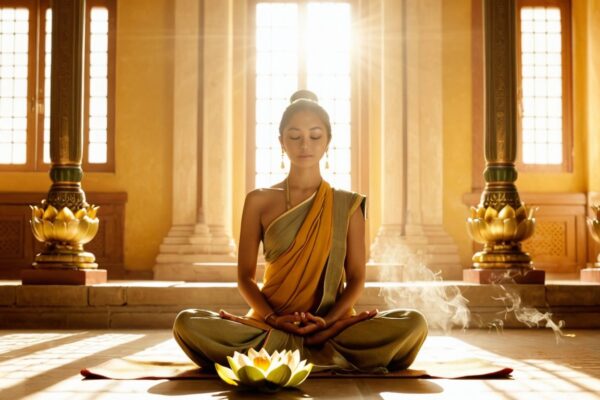
Vipassana is perhaps the simplest meditation instruction ever given: watch the breath. Sit comfortably, close your eyes, and bring the attention to the sensation of breathing — specifically to the sensation at the nostrils, where the air touches as it enters and leaves.
Don’t control the breath. Don’t deepen it or make it more “spiritual.” Simply watch it exactly as it is. When the mind wanders — and it will wander, constantly — simply notice that it has wandered, and gently return the attention to the breath. No judgment. No self-criticism. Just return. Again and again.
The Gap Between Breaths
Osho pointed to something specific within Vipassana that is easy to miss: the gap between breaths.
“Watch carefully,” he said. “After the exhalation there is a moment before the inhalation begins. In that moment, the breath stops. And in that stopping, something extraordinary becomes available — a taste of the timeless, a taste of the deathless.”
“The gap between two breaths — this is the window into eternity. It has always been there. You simply need to learn to look.”
— Osho
What Develops Over Time
In more extended Vipassana practice, the meditation expands from the breath to the entire body. The attention moves systematically through each part, observing sensations with complete equanimity: neither attracted to pleasant sensations nor repelled by unpleasant ones.
This practice of body-scanning develops a profound understanding of impermanence. Every sensation arises, and every sensation passes. Without exception. The most intense pain passes. The most exquisite pleasure passes. Everything in consciousness is impermanent — arising and dissolving like waves on a surface that itself never moves.
Even ten minutes of daily Vipassana has significant effects over time. The ideal is two sittings per day of forty-five minutes to an hour each. But Osho was practical: “Start with whatever you can sustain. Five minutes of sincere practice is worth more than an hour of mechanical sitting.”
Step-by-Step Practice Protocol
The protocols below come from documented spiritual, psychological, or contemplative traditions. They support self-reflection and skill-building — not medical diagnosis, crisis care, or literal prediction of future events.
Practice Osho active meditations exactly as staged — catharsis first, silence second. Not suitable during acute psychiatric crisis without professional guidance.
Time needed: 45–60 minutes (technique-dependent)
- Empty stomach (2+ hours after food); loose clothes; safe floor space; inform housemates if loud stages are used.
- Use official stage-timed music if available (10+10+10+15+15 for Dynamic) — timers prevent guessing.
- Stage 1–3: follow breath, expression, and movement instructions fully; do not suppress sound or shaking.
- Stage 4 (freeze/stillness): stop instantly; remain a statue; witness sensations without fixing them.
- Stage 5: gentle movement or celebration as instructed; lie down 5 minutes after if dizzy.
- Journal immediately: what released, what silence felt like, one integration action for the day. Skip driving until grounded.
Tradition & references: Published Osho International Foundation stage instructions for Dynamic, Kundalini, Nadabrahma, and related meditations; Vigyan Bhairav Tantra (translated sutras, reflective context).
Common Misconceptions and Refinements
While Vipassana’s instructions appear simple, several common misunderstandings can hinder progress. Firstly, the breath is not an object to be controlled or manipulated. The instruction “watch the breath” is often misinterpreted as a directive to deepen, shorten, or otherwise manage the respiratory process. This introduces effort and judgment, pulling the practitioner away from the core principle of non-intervention. The breath is merely an anchor, a neutral, ever-present phenomenon to which attention can gently return. Its natural rhythm, length, and depth are precisely what should be observed, without any attempt to alter it.
Secondly, the concept of “returning the attention” is frequently met with self-reproach. When the mind wanders, there’s a tendency to critique oneself for lack of focus or discipline. This judgment itself is another form of mental activity that pulls away from the present moment. The practice is not about achieving a perfectly still mind, but about cultivating the awareness of mind-wandering and the gentle, non-judgmental act of redirection. Each return is a strengthening of the “witnessing muscle,” not a failure to be lamented.
Finally, equanimity is often confused with indifference or suppression of emotion. True equanimity in Vipassana means observing sensations—whether pleasant, unpleasant, or neutral—without attachment or aversion. It’s not about becoming numb, but about understanding that all experiences are transient. When a strong emotion arises, the practice is to observe its physical manifestations, its duration, and its eventual passing, rather than getting entangled in its narrative or trying to push it away. This allows for a deeper processing of experience, free from reactive patterns.
Psychological Underpinnings of Vipassana
From a modern psychological perspective, Vipassana functions as a powerful training in metacognition and emotional regulation. By consistently returning attention to the breath, practitioners develop an enhanced capacity for self-monitoring—the awareness of one’s own thought processes and mental states. This metacognitive ability is crucial for recognizing cognitive distortions and interrupting habitual, unhelpful mental loops.
The systematic observation of sensations, particularly the body scan, directly addresses the psychological phenomenon of *experiential avoidance*. Often, individuals unconsciously suppress or avoid unpleasant internal experiences (thoughts, feelings, sensations), which paradoxically intensifies them or leads to maladaptive coping mechanisms. Vipassana teaches a radical acceptance of all present-moment experience. By observing discomfort without resistance, the practitioner learns that even intense sensations are impermanent and do not inherently require a reactive response. This cultivates a sense of psychological flexibility, allowing individuals to remain present and aligned with their values even in the face of internal distress.
Furthermore, the emphasis on the “gap between breaths” and the observation of impermanence directly challenges the ego’s tendency towards reification—the treating of abstract concepts or fleeting experiences as concrete, stable entities. By witnessing the constant flux of sensations, thoughts, and emotions, the practice deconstructs the illusion of a fixed, separate self. This can lead to a reduction in self-referential processing, a common feature in anxiety and depression, and foster a more fluid, interconnected sense of being.
The Historical Roots: From Buddha to Modern Practice
While Osho brought Vipassana to a new generation, its lineage stretches back over two and a half millennia. The technique is directly derived from the teachings of Gautama Buddha, as recorded in the Satipatthana Sutta (Discourse on the Foundations of Mindfulness). This ancient Pali text outlines the four foundations of mindfulness: mindfulness of the body, feelings, mind, and mental objects. At its core, the Satipatthana Sutta describes a systematic path to insight through direct observation of phenomena.
For centuries, Vipassana was primarily preserved within monastic traditions, particularly in Theravada Buddhist countries like Myanmar, Sri Lanka, and Thailand. A significant revitalization of Vipassana for lay practitioners occurred in the early 20th century, largely through the efforts of figures like Ledi Sayadaw in Myanmar. His student, S.N. Goenka, became instrumental in bringing Vipassana to a global audience in the latter half of the 20th century, establishing centers worldwide that adhere to a specific 10-day retreat format. Goenka’s approach, while rooted in the same ancient tradition, emphasized a secular presentation, making it accessible to people of all backgrounds, regardless of their religious beliefs.
It’s important to note that while the core principle of “seeing things as they are” remains consistent, different lineages and teachers may emphasize slightly different aspects or present the practice with varying cultural and philosophical contexts. Osho’s unique contribution was to frame Vipassana not just as a technique, but as a fundamental attitude of witnessing that could permeate all aspects of life, often integrating it with more active, cathartic meditative practices to clear away psychological blockages before settling into stillness.
Psychological Insights: Vipassana and the Unconscious
From a depth-psychological perspective, Vipassana offers a profound method for engaging with the unconscious. Carl Jung, though not a meditator in the Buddhist sense, spoke extensively about the importance of integrating unconscious material for individuation. Vipassana, through its non-judgmental observation of thoughts, emotions, and bodily sensations, provides a direct pathway to this integration.
When we sit in Vipassana, the mind’s incessant chatter, its “monkey mind,” begins to reveal its patterns. These patterns are often deeply rooted in past experiences, conditioning, and unconscious complexes. By simply observing these mental formations without engagement or suppression, the practitioner creates a space between the observing consciousness and the observed content. This space is crucial. It allows for a disidentification from the ego’s narratives and a clearer perception of how these narratives influence our experience of reality.
The practice of observing sensations throughout the body also taps into what Jung termed the “somatic unconscious.” Trauma, repressed emotions, and psychological tensions often manifest as physical sensations, tightness, or discomfort. Vipassana encourages us to meet these sensations with equanimity, rather than reacting to them with aversion. This gentle, sustained attention can allow deeply held energetic patterns to surface and release, often leading to profound emotional and psychological shifts without the need for intellectual analysis. It’s a process of “unbinding” the psyche from its habitual responses, fostering a more integrated and flexible sense of self.
Real-Life Application: Beyond the Cushion
The profound insights cultivated on the meditation cushion are not meant to remain confined to it. The essence of Vipassana—”seeing things as they are”—is a skill that can transform daily life. This is where the practice truly blossoms into a living wisdom.
Consider the professional realm. In high-pressure situations, the ability to observe internal reactions (stress, frustration, fear) without being overwhelmed by them allows for more considered, effective responses. Instead of reacting impulsively, one can pause, observe the rising sensation, and choose a course of action rooted in clarity rather than emotional turbulence. This is a direct application of the equanimity developed in Vipassana: meeting challenging situations with an open awareness, rather than habitual defense mechanisms.
In relationships, Vipassana fosters deeper empathy and understanding. By becoming more attuned to our own internal landscape, we develop a greater capacity to witness the inner worlds of others. When a partner or friend expresses an emotion, the Vipassana practitioner can observe their own reactive tendencies (e.g., to fix, to judge, to withdraw) and instead choose to simply be present with the other’s experience, without entanglement. This non-reactive presence can be profoundly healing and strengthening for interpersonal bonds.
Even in mundane activities like eating, walking, or doing chores, the Vipassana attitude can bring a richness and presence often lost in our fast-paced lives. Eating mindfully, for example, becomes an opportunity to truly taste, smell, and feel the food, rather than simply consuming it while distracted. Walking becomes an awareness of the body’s movement, the ground beneath the feet, and the surrounding environment. These seemingly small shifts accumulate, leading to a life lived with greater intentionality, less reactivity, and a deeper appreciation for the simple fact of being present.

Meditation & Yoga Teacher
Anil Prakash has practiced and taught meditation and pranayama for fifteen years across several traditions, from MBSR to the active methods of Osho. He writes step-by-step, evidence-aware guides and always notes contraindications and safe practice.
Read Anil Prakash's full profile →✦
Editorial Standards
Practices on AfterDarkIntuition are researched from depth psychology (Jung), established spiritual traditions, and contemporary therapeutic frameworks. They are for self-reflection and personal growth — not medical, psychiatric, or crisis care. If you are in crisis, please contact a licensed professional or emergency services. About our editorial approach →
Editorial Note
Written for self-reflection and spiritual exploration. Not medical or psychological advice. Our editorial standards →
Written for self-reflection and spiritual exploration. Not medical or psychological advice. Our editorial standards →