Ancestral Healing
Jun 25, 2026
·
9 min read
·
Updated Jul 26, 2026
Working With Difficult Ancestors: When the Lineage Carries Harm

🕯 7 min read · June 25, 2026
Working With Difficult Ancestors: When the Lineage Carries Harm
Have you ever felt a recurring pattern of anxiety, a specific type of anger, or a crushing sense of failure that does not seem to belong to your own life experiences? Perhaps you look at your family tree and see a legacy of addiction, abuse, or systemic cruelty, and you feel a visceral repulsion toward the blood that flows through your veins. For many, the concept of ancestral healing is presented as a cozy reunion with benevolent spirits. But for those whose lineage carries a history of harm, the idea of connecting with ancestors can feel less like a homecoming and more like stepping into a minefield.
When the lineage carries harm, the spiritual work shifts. It is no longer about simple gratitude; it is about discernment, boundary setting, and the courageous act of breaking cycles. Healing does not require you to excuse the inexcusable, nor does it demand that you invite every ancestor into your sacred space. It requires a grounded approach to reclaiming your autonomy while acknowledging the energetic imprint of those who came before.
Understanding the Weight of Epigenetics and Archetypes
Before engaging in spiritual practice, it is helpful to understand that the burdens we carry are often both biological and psychological. Modern science points toward epigenetics, the study of how trauma can leave chemical marks on genes, affecting the stress responses of subsequent generations. When a grandparent survived a famine or a war, the descendants may inherit a hyper-vigilant nervous system.
From a psychological perspective, Carl Jung described the collective unconscious and the concept of the shadow. The shadow consists of the parts of ourselves—and our lineage—that we deem unacceptable and push into the darkness. When a family suppresses a history of violence or betrayal, that shadow does not disappear; it manifests as unconscious patterns in the descendants. Working with difficult ancestors is, in essence, a process of shadow work. It is the act of bringing the hidden harm into the light so that it can be processed rather than repeated.
The Ethics of Ancestral Boundaries
A common misconception in spiritual circles is that we owe unconditional loyalty to our ancestors. However, true healing requires a boundary between honor and alignment. You can honor the fact that your ancestors provided the biological bridge for your existence without honoring the choices they made.
In many traditional frameworks, there is a distinction between the Ancestors of Blood and the Ancestors of Choice. While you cannot choose your bloodline, you can cultivate a relationship with the Ancestors of Choice—those spiritual teachers, mentors, and historical figures whose virtues you wish to emulate. If your bloodline is currently too toxic to engage with safely, shifting your focus to these chosen ancestors provides a stable foundation of safety from which you can eventually address the more difficult lineage work.
Practical Approaches to Clearing the Lineage
If you feel ready to address the harm within your lineage, the goal is not to change the past, but to change your relationship to it. The objective is to stop the transmission of trauma.
Somatic Grounding and Mindfulness
Before any spiritual work, the body must be regulated. Trauma resides in the nervous system, not just the mind. Using techniques from Mindfulness-Based Stress Reduction (MBSR), you can create a container of safety.
Begin by practicing the body scan. Lie flat on your back and slowly bring awareness to each part of your body, noting areas of tension without judgment. When you feel a surge of anger or grief related to your family history, do not push it away. Instead, observe the physical sensation—the tightening of the chest or the heat in the throat. By witnessing the emotion without reacting to it, you decouple the ancestral trigger from your current identity.
The Use of Elder Futhark for Reflection
For those who use runes, the Elder Futhark provides a structured way to analyze the nature of the lineage harm. Rather than using runes for divination or predicting the future, use them as psychological mirrors.
You might draw a single rune to represent the current state of your lineage. If you draw Hagalaz (hail/disruption), it may indicate that a period of necessary destruction is occurring—the breaking of an old, harmful pattern. If you draw Isa (ice/stasis), it may suggest a generational freeze, where a truth has been suppressed for decades. The runes serve as a catalyst for introspection, asking you: What is the specific nature of this harm, and how is it manifesting in my life today?
The Role of the Rider-Waite-Smith Tarot
The RWS tarot can be used to map the family dynamic through archetypes. By laying out cards for different generations, you can identify where the rupture occurred. For example, seeing the Three of Swords in a grandparent’s position may highlight a legacy of heartbreak or betrayal. The goal here is not to judge the ancestor, but to identify the wound. When you name the wound, you stop being a victim of the pattern and start becoming the observer of the pattern.
A Step-by-Step Practice for Tonight
If you feel a heavy presence or a lingering sense of familial guilt, you can perform this grounding ritual tonight. This is not a ritual of invitation, but a ritual of boundary setting.
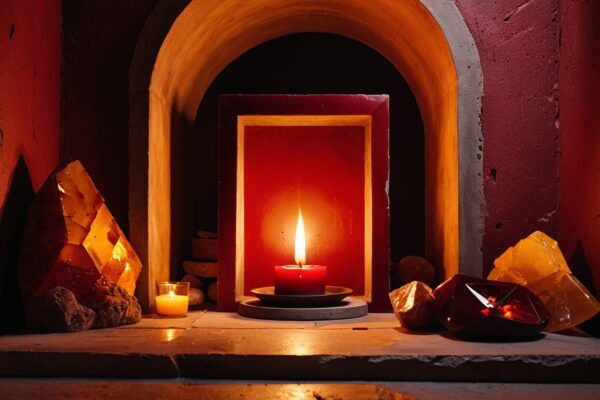
- Prepare your space. Clean your room and light a single candle. This symbolizes the light of consciousness entering the darkness of the unconscious.
- Create a physical boundary. Use a piece of string, a circle of salt, or simply imagine a sphere of clear light surrounding you. State clearly: I am the sovereign authority of my own energy.
- The Statement of Release. Speak aloud the following or a variation of it: I acknowledge the lives of those who came before me. I acknowledge the pain they carried and the harm they caused. I honor the life force that reached me, but I release the patterns of harm. I return the burdens that are not mine to carry.
- The Visualization. Imagine the heavy, dark threads of trauma leaving your body and returning to the earth to be composted. See the earth absorbing the energy and transforming it into neutral soil.
- Closing. Extinguish the candle and drink a glass of water. This signals to your subconscious that the work is finished and you are returning to the present moment.
Safety Note: If you have a history of severe trauma or PTSD, please perform this work in conjunction with a licensed therapist. Spiritual practices can surface repressed memories that require professional support to integrate safely.
Integration Through Movement and Breath
Healing is not purely mental; it is physical. B.K.S. Iyengar emphasized the importance of precision and alignment in yoga to balance the body’s energy. To move ancestral grief through the body, focus on heart-opening postures or grounding poses like Tadasana (Mountain Pose). As you stand firmly on the earth, feel the support of the ground beneath you. Remind yourself that you are the point where the lineage changes. You are the one who is conscious enough to say, this ends with me.
Moving Toward the Ancestors of Light
As you clear the debris of the difficult ancestors, you create space for the ancestors of light. These are the ones who were also outliers in the family—the ones who were exiled for being too kind, the ones who secretly resisted the family’s cruelty, the ones who dreamed of a better way.
By intentionally connecting with these hidden allies, you realize that you were never truly alone in your struggle. There has always been a thread of resilience and integrity in your line, even if it was whispered or hidden. By amplifying that thread, you rewrite the narrative of your lineage from one of harm to one of recovery.
The process of ancestral healing is a slow unfolding. It is not a one-time event but a lifelong practice of discernment. You are not responsible for the sins of your fathers, but you are responsible for the healing of your own heart. By doing this work, you are not only freeing yourself; you are clearing the path for every generation that will follow you. You are becoming the ancestor that future generations will look back upon with gratitude, knowing that you had the courage to stop the cycle.
Frequently Asked Questions
Do I have to forgive my ancestors to heal?
No. Healing is about liberation and boundary setting, not forced forgiveness. You can release the energetic hold a person has on you without condoning their actions or granting forgiveness.
Can ancestral work cause physical illness?
Spiritual work does not cause disease, but the emotional release of stored trauma can cause temporary fatigue or emotional volatility. This is a natural part of the somatic release process and is usually managed with grounding and rest.
What if I do not know my family history?
You can work with the general archetype of the lineage. The body remembers the trauma even if the mind does not have the facts; focusing on your own recurring patterns is a valid way to identify and heal ancestral harm.
This page describes what the Ancestral Healing tradition teaches and how people practise it. It is not a prediction and not medical, psychiatric or crisis advice. How we research and write · report an error