Seasonal Magic
Jun 25, 2026
·
10 min read
Yule: The Winter Solstice and the Return of the Light
🕯 8 min read · June 25, 2026
# Yule: The Winter Solstice and the Return of the Light
Have you ever noticed how the deepest silence of the year often arrives just before the most profound shift in your internal landscape? There is a specific, heavy stillness that descends during the final days of December, a quality of air that feels thick with anticipation. For those who live in tune with the natural cycles of the earth, this is not merely a change in weather, but the arrival of Yule. It is the moment when the physical world reaches its lowest ebb of light, and the spiritual world begins its slow, inevitable ascent.
Yule represents the Winter Solstice, the shortest day and longest night of the year. While modern society often views this period through the lens of commercial holiday stress, the spiritual essence of Yule is rooted in the paradox of the dark. It is the celebration of the return of the light, not because the light has arrived in full, but because the turning point has been reached. It is the seed beneath the snow, the spark in the hearth, and the quiet realization that no winter lasts forever.
The Archetype of the Dark Night
To understand Yule is to understand the necessity of the void. In Jungian psychology, the concept of the shadow represents the unconscious parts of the personality that we often repress or ignore. The Winter Solstice is the seasonal manifestation of this shadow work. Just as the earth must retreat into a period of dormancy to regenerate its nutrients, the human psyche requires periods of withdrawal and introspection to integrate growth.
The solstice is an invitation to enter the dark without fear. In the tradition of Mindfulness Based Stress Reduction (MBSR), this period aligns with the practice of mindful awareness—observing the discomfort of cold, loneliness, or stagnation without trying to fix it immediately. By sitting with the stillness of Yule, we move from a state of resistance to a state of acceptance. We acknowledge that the darkness is not an enemy to be defeated, but a womb in which the next version of ourselves is being formed.
Historical Roots and Cultural Traditions
The term Yule originates from the Old Norse Yól, a midwinter festival observed by Germanic and Scandinavian peoples. These traditions were centered around the survival of the community and the honoring of the suns return. The Yule log, a massive piece of oak or ash burned in the hearth, served as a physical anchor for the home, providing warmth and light while symbolizing the rekindling of the solar fire.
These practices were grounded in the reality of the agrarian calendar. The solstice was a time of storytelling and kinship, where the oral histories of the ancestors were passed down during the long nights. This period of storytelling served a vital psychological function: it reminded the community of their resilience and their connection to a lineage that had survived countless winters before.
In the Norse tradition, the use of the Elder Futhark runes often accompanied this season. The rune Dagaz, representing dawn and the breakthrough of light, is particularly resonant during Yule. It symbolizes the transition from one state of being to another, mirroring the exact astronomical shift of the solstice. It is not a promise of a fixed fate, but a reminder of the capacity for transformation.
The Energetic Shift: From Dormancy to Awakening
The spiritual transition of Yule is a movement from the external to the internal. Throughout the autumn, we shed what is no longer serving us, much like the deciduous trees. By the time we reach the solstice, we are stripped bare. This is the point of maximum vulnerability, but also maximum potential.
In the context of Iyengar yoga, this period encourages a focus on grounding and stability. Practices that emphasize the root and the core help the practitioner feel secure in their physical vessel while the external environment is harsh. By focusing on the alignment of the body and the steadiness of the breath, we create an internal sanctuary that allows us to weather the psychological winter.
This transition mirrors the stages of consciousness described by Osho in his explorations of meditation, where the movement from noise to silence is a prerequisite for true awareness. The solstice provides a natural window to practice this descent into silence, allowing the clutter of the year to settle so that the inner voice can finally be heard.
Practical Applications for the Solstice
Integrating the energy of Yule does not require elaborate altars or expensive tools. It requires a willingness to be present with the silence. Here are grounded, step by step instructions for a solstice practice you can perform tonight to align yourself with the return of the light.
The Ritual of the Inner Hearth
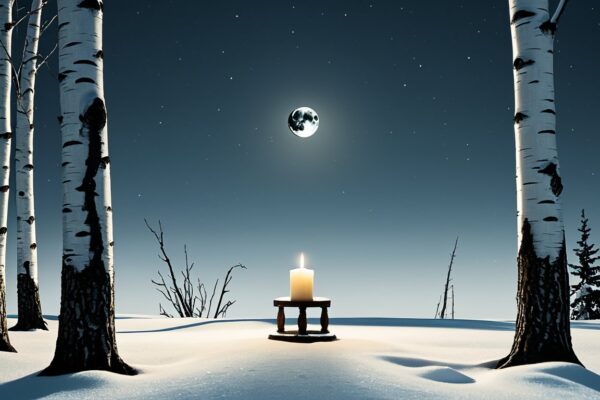
- Prepare your space. Dim the overhead lights and light a single candle or sit by a fireplace. Ensure the room is quiet and the temperature is comfortable.
- The Breath of Stillness. Sit in a comfortable position with a straight spine. Close your eyes and take ten slow, deep breaths. With every exhale, imagine you are sinking deeper into the earth, releasing the tensions of the past year.
- The Review of the Shadow. Reflect on the challenges you faced this year. Instead of viewing them as failures, view them as the winter soil. Ask yourself: What did this darkness teach me? What part of me had to go dormant so that something else could grow?
- The Spark of Intent. Look into the flame of your candle. Focus on one specific quality you wish to cultivate as the days begin to lengthen—perhaps patience, clarity, or courage. Do not treat this as a wish, but as a seed you are planting.
- The Closing. Extinguish the candle or let the fire burn down, acknowledging that the light is now carried within you.
Safety Note: Always exercise caution when using open flames. Ensure candles are placed on stable, heat resistant surfaces and never leave them unattended.
Divination as a Tool for Reflection
Many practitioners turn to the Rider Waite Smith (RWS) tarot during Yule to gain perspective. Rather than using the cards to predict the future, the solstice is an ideal time for a reflective spread.
A simple three card draw can provide clarity:
The first card represents what is currently in the shadows (what needs attention).
The second card represents the seed of potential (what is beginning to grow).
The third card represents the light to move toward (the guiding principle for the coming season).
By viewing the tarot as a mirror of the subconscious rather than a crystal ball, the practitioner uses the imagery to trigger intuitive insights. The cards act as prompts for the mind to connect disparate thoughts, facilitating a deeper understanding of one’s own psychological landscape.
The Psychology of Hope and the Return of Light
The return of the light is a powerful metaphor for the human capacity for hope. Hope, in a spiritual sense, is not a blind optimism that everything will be perfect. Instead, it is the grounded knowledge that the cycle continues.
When we celebrate Yule, we are acknowledging the law of polarity. There is no light without dark, and there is no growth without a period of rest. By honoring the solstice, we stop fighting the winter and start utilizing it. We learn that the period of waiting is not wasted time; it is the essential preparation for the spring.
This alignment with natural cycles reduces the anxiety associated with the pressure to be constantly productive. Yule gives us permission to be still. It validates the need for sleep, reflection, and solitude. In a world that demands constant visibility and activity, the solstice is a radical act of slowing down.
Integrating the Solstice into Daily Life
Beyond a single night of ritual, the energy of Yule can be integrated into your daily routine throughout the month of December.
Practice the art of the long walk. Spend time in nature during the dimmest hours of the afternoon. Observe the skeletal beauty of the trees and the resilience of the evergreen. This practice grounds the spirit and reminds the mind that life persists even when it is not visible.
Engage in conscious solitude. Set aside thirty minutes a day for complete silence. No phones, no books, no music. Simply exist in the space. This creates a vacuum that allows new insights to enter, mirroring the astronomical shift of the solstice.
Cultivate warmth through community. Share a meal or a conversation with loved ones, focusing on gratitude and shared history. This mirrors the ancient Yule tradition of kinship and reinforces the social bonds that provide emotional security during the colder months.
The Eternal Cycle
Yule is a reminder that the universe is in a state of constant motion. Nothing is static. The longest night is the very moment that the days begin to lengthen. The peak of the darkness is the beginning of the light.
As you move through the winter months, remember that you are not alone in your longing for the sun. Every living thing is currently engaged in the same process of quiet endurance and patient waiting. By aligning your internal rhythm with the external cycle of the earth, you move from a state of struggle to a state of flow. You realize that the darkness is not a wall, but a doorway.
The return of the light is a gradual process. It does not happen in a flash, but in increments of minutes and seconds. This teaches us the value of patience and the beauty of the subtle shift. As the light returns to the world, let it return to your heart, one small spark at a time.
Frequently Asked Questions
Is Yule the same as the Winter Solstice?
The Winter Solstice is the astronomical event of the shortest day of the year. Yule is the spiritual and cultural celebration associated with this event, rooted in various Northern European traditions.
Do I need specific tools or altars to celebrate Yule?
No. The essence of Yule is the transition from dark to light, which can be honored through simple acts of reflection, mindfulness, and the use of a single candle or a walk in nature.
Can tarot or runes tell me exactly what will happen in the new year?
No. These tools are used for introspection and psychological reflection. They provide archetypal prompts to help you understand your current state and potential paths, but they do not reveal a fixed or inevitable fate.
This page describes what the Seasonal Magic tradition teaches and how people practise it. It is not a prediction and not medical, psychiatric or crisis advice. How we research and write · report an error