Tarot
Jun 25, 2026
·
9 min read
·
Updated Jul 26, 2026
Court Cards Explained: Pages, Knights, Queens, and Kings Made Simple
🕯 7 min read · June 25, 2026
Court Cards Explained: Pages, Knights, Queens, and Kings Made Simple
Have you ever laid out a beautiful spread, only to find your momentum halted by a sudden cluster of court cards? Perhaps you are reading for a complex situation, and instead of a clear action or a definitive outcome, you are met with a Page of Swords and a Queen of Pentacles. You find yourself wondering: Is this a specific person in my life? Is it a personality trait I need to adopt? Or is it a message about a specific stage of emotional maturity?
For many practitioners, the court cards are the most intimidating part of the Rider-Waite-Smith (RWS) system. While the Major Arcana provide the cosmic architecture and the pips provide the situational details, the court cards represent the human element. They are the mirrors reflecting our psychological states, the actors in our social dramas, and the archetypes of our internal growth.
To master the court cards, one must move away from the idea that they are merely people. When we limit a King to a father figure or a Page to a child, we miss the psychological depth of the reading. Instead, view these cards through the lens of maturity and energy.
The Hierarchy of Maturity: From Seed to Sovereignty
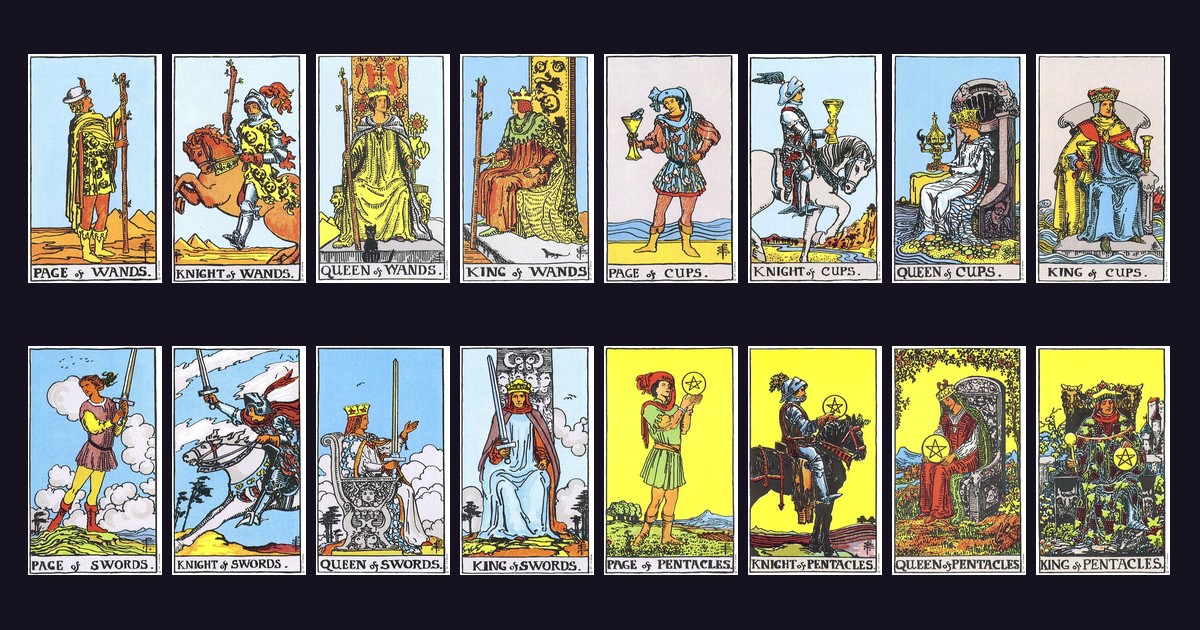
The court cards represent a progression of mastery. In the RWS tradition, this progression moves from the curiosity of the Page to the authority of the King. Understanding this gradient allows you to read the court cards as stages of development rather than fixed identities.
The Pages: The Seed of Potential
Pages are the students of the tarot. They represent the earliest stage of an energy. When a Page appears, the energy is fresh, tentative, and often experimental. In psychological terms, this aligns with the concept of the beginner’s mind, a state of openness and eagerness.
A Page is not always a young person; they are anyone in a learning phase. If the Page of Cups appears during a career reading, it may not indicate a young employee, but rather a new emotional approach to work or a creative spark that has yet to be refined. Pages bring messages, news, and the invitation to explore. They are the spark of an idea before it becomes a plan.
The Knights: The Energy of Action
If the Page is the seed, the Knight is the sprout breaking through the soil. Knights represent movement, drive, and the application of the suit’s energy. They are the messengers of the deck, characterized by momentum.
However, Knights can be volatile. Because they are driven by impulse and passion, they often lack the stability of the higher courts. A Knight can represent a period of rapid progress, but they can also signal recklessness. In a reading, a Knight asks: How is this energy being pushed forward? Is it a focused charge (Knight of Swords) or a slow, steady trek (Knight of Pentacles)?
The Queens: The Mastery of Internalization
The Queens represent the mastery of the internal world. While the Kings rule the external environment, the Queens rule the emotional and intuitive landscape. They are the architects of stability and nurturing.
A Queen does not need to act to be powerful; her power lies in her presence and her ability to manage the energy of her suit. When a Queen appears, the focus shifts from doing to being. The Queen of Swords, for example, represents the mastery of intellectual clarity and boundaries. She does not fight the battle; she provides the strategy and the discernment required to win it.
The Kings: The Mastery of Externalization
The Kings are the ultimate authority of their respective suits. They represent the ability to project the energy of their element into the physical world to create tangible results. A King is the master of his domain, possessing the discipline and experience to lead.
When a King appears, it suggests a state of stability, leadership, and responsibility. However, the shadow side of the King is rigidity. A King who has lost his balance becomes a tyrant. In a reading, the King asks: Where is the structure? Who is taking responsibility? What does the highest expression of this suit look like in practice?
Integrating the Elements: Suit and Rank
To read a court card simply, combine the rank (the stage of maturity) with the suit (the elemental energy).
The suit of Cups deals with water, emotions, and relationships. A Page of Cups is a new feeling; a King of Cups is emotional maturity and composure.
The suit of Swords deals with air, intellect, and conflict. A Page of Swords is curiosity and mental agility; a King of Swords is objective truth and legalistic precision.
The suit of Wands deals with fire, passion, and ambition. A Page of Wands is a spark of inspiration; a King of Wands is the visionary leader who turns a dream into a reality.
The suit of Pentacles deals with earth, materiality, and the physical body. A Page of Pentacles is a new study or a small financial start; a King of Pentacles is the provider and the master of the material realm.
Practical Application: How to Read Court Cards Tonight
If you want to integrate these meanings into your practice immediately, try this guided exercise tonight. This method moves from the intellectual understanding to an intuitive connection.
Step 1: The Single Card Draw
Clear your space and shuffle your deck. Draw one court card. Do not look at a guidebook. Look at the figure’s posture, their gaze, and their environment.
Step 2: The Mirror Exercise
Ask yourself: How does this card describe my current mood? If you draw the Queen of Swords, ask where you are being discerning or where you are being too cold. This shifts the card from a person in your life to a reflection of your own psyche.
Step 3: The Relationship Dynamic
Draw a second court card. Place it next to the first. Observe the interaction. Is the Knight challenging the King? Is the Page learning from the Queen? This helps you see the court cards as a dialogue of energies rather than isolated definitions.
Step 4: Journaling the Archetype
Write one sentence describing the card as a personality trait. For example: The Knight of Pentacles is the patience to do a job correctly the first time.
Safety Note: When using tarot for spiritual guidance, remember that these cards reflect archetypes and possibilities. They are tools for introspection and psychological mapping. They should never be used to diagnose mental health conditions or as a substitute for professional legal or financial advice.
The Psychological Perspective: Tarot and the Collective Unconscious
The effectiveness of the court cards lies in their alignment with what Carl Jung called the collective unconscious. Jung proposed that certain archetypes—the Mother, the Father, the Child, the Warrior—are universal patterns shared by all humans.
The court cards are a visual shorthand for these archetypes. The Queen is the Divine Feminine, the nurturing and intuitive force. The King is the Divine Masculine, the protective and structuring force. The Page and Knight represent the journey from innocence to experience. When we read these cards, we are not predicting a fixed fate; we are identifying which archetypal energy is currently dominant in the querent’s life.
This approach removes the anxiety of the unknown. Instead of wondering if a card predicts a specific person’s arrival, you can ask: Which part of my internal architecture is currently active? Am I acting as the impulsive Knight or the discerning Queen?
Navigating the Complexity of People and Personas
While court cards can represent personality traits, they can also represent actual people. To distinguish between a trait and a person, look at the surrounding cards.
If a court card is surrounded by pips (numbered cards), it is more likely to be a personality trait or a psychological state. For example, the Queen of Cups surrounded by the Three of Swords suggests an emotional state of grief and healing.
If a court card is surrounded by other court cards or Major Arcana, it is more likely to represent a specific individual or a social dynamic. A King of Pentacles sitting next to the Emperor often points to a powerful patriarch or a boss.
By treating the court cards as a spectrum of maturity, you transform the most confusing part of the deck into its most rewarding. You stop searching for names and start searching for meanings.
The beauty of the tarot is that it provides a language for the things we feel but cannot name. The court cards give us the vocabulary for the human experience, reminding us that we all fluctuate between these roles. We are all students (Pages) one day, warriors (Knights) the next, nurturers (Queens) in our private lives, and leaders (Kings) in our professional spheres. By embracing this fluidity, you allow the cards to guide you toward a more integrated version of yourself.
Frequently Asked Questions
Can a court card represent a person’s gender regardless of the card’s title?
Yes. In modern practice, the energy of the card (the archetype) is more important than the gender depicted. A Queen can represent a nurturing man, and a King can represent a commanding woman.
Do court cards always indicate a third party in a relationship reading?
Not necessarily. They often represent the internal emotional state of one of the partners or a specific energy (like the Knight of Swords’ abruptness) affecting the relationship.
Is it possible for one person to be represented by multiple court cards?
Yes. A person may be a King of Pentacles in their career (stable and wealthy) but a Page of Cups in their romantic life (emotionally inexperienced or tentative).
This page describes what the Tarot tradition teaches and how people practise it. It is not a prediction and not medical, psychiatric or crisis advice. How we research and write · report an error