Tarot
Jun 25, 2026
·
9 min read
·
Updated Jul 5, 2026
Wheel of Fortune: Cycles, Karma, and Turning Points in Tarot
🕯 7 min read · June 25, 2026
Wheel of Fortune: Cycles, Karma, and Turning Points in Tarot
Have you ever felt as though your life was moving in a perfect circle, where the same challenges, the same personality clashes, and the same emotional hurdles reappear just as you thought you had finally overcome them? Or perhaps you have experienced a sudden, unexpected shift in circumstances—a phone call, a chance encounter, or a sudden loss—that completely rerouted your trajectory in a single afternoon. These moments are the lived experience of the Wheel of Fortune. In the architecture of the Tarot, this card serves as the bridge between our personal agency and the vast, impersonal currents of existence.
The Symbology of the Wheel: A Universal Language
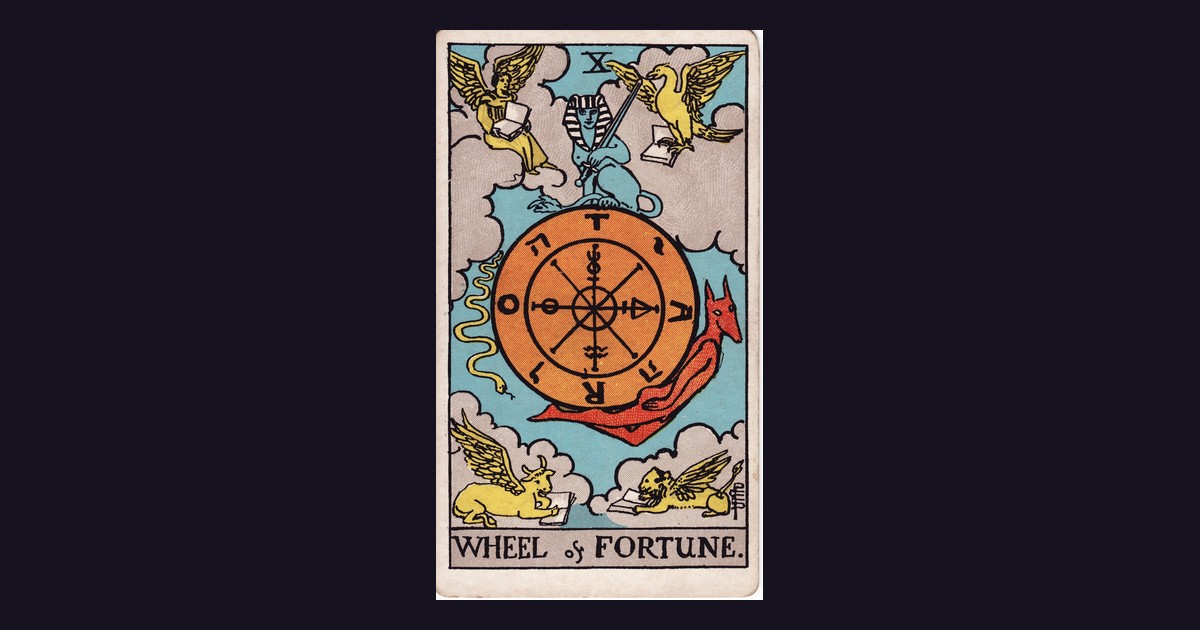
In the Rider Waite Smith tradition, the Wheel of Fortune is a dense pattern of esoteric symbols. At the center, the wheel turns, carrying the Sphinx, a creature of synthesis representing the union of human intelligence and animal instinct. Around the perimeter, we see the four living creatures—the angel, the eagle, the lion, and the ox—which correspond to the four fixed signs of the zodiac and the four elements of nature.
This imagery suggests that while the world is in constant motion, there is a center point of stillness. The Sphinx represents the observer who remains centered while the external world spins. When this card appears in a reading, it rarely speaks of a static destination. Instead, it signals a transition. It is the card of the turning point, reminding the seeker that the current state of affairs is temporary. Whether you are at the apex of success or the nadir of despair, the Wheel reminds you that the only constant is change.
Karma and the Law of Cause and Effect
To understand the Wheel of Fortune is to engage with the concept of karma, not as a system of cosmic punishment, but as a law of cause and effect. In various Eastern philosophies, karma is simply the momentum created by action. The Wheel illustrates that our current circumstances are often the harvest of seeds planted in the past, but it also emphasizes that our current responses determine the seeds we plant for the future.
Carl Jung, the Swiss psychiatrist, described this phenomenon through the concept of synchronicity—the occurrence of meaningful coincidences that seem to defy linear causality. When the Wheel appears, it often indicates a synchronicity. It suggests that the external events occurring in your life are mirroring an internal psychological shift. The turning of the wheel is not a random act of fate, but a reflection of a cycle reaching its natural conclusion.
Navigating the Cycles of Life
Life does not move in a straight line; it moves in spirals. We revisit the same lessons, but each time we encounter them, we do so from a higher vantage point. This is the difference between being trapped in a loop and evolving through a cycle.
The Psychological Cycle
From a psychological perspective, the Wheel represents the archetypal experience of rise and fall. We experience the expansion of the ego during periods of success and the contraction of the ego during periods of loss. By recognizing these as natural cycles, we can avoid the trap of extreme emotional reactivity. When we are at the top, we practice humility; when we are at the bottom, we practice hope.
The Spiritual Cycle
In the context of spiritual growth, the Wheel represents the process of shedding. Just as the seasons change, our souls undergo periods of winter, where we must withdraw and introspect, and periods of spring, where we are called to act and grow. The frustration we feel when the wheel turns downward is usually a resistance to this natural rhythm. The goal is not to stop the wheel from turning, but to find the still point at the center where we are no longer tossed about by the winds of circumstance.
Practical Integration: How to Work with the Wheel Tonight
If you feel stuck in a repetitive cycle or are facing an unexpected turning point, you can use these grounded practices to regain your center. These methods combine tarot reflection with mindfulness and somatic awareness to help you navigate the shift.
Step 1: The Reflective Spread
Clear a quiet space and light a candle or dim the lights to signal to your brain that you are entering a period of introspection. Shuffle your deck and draw three cards:
- The Current Momentum: What is the primary energy driving the wheel right now?
- The Lesson of the Cycle: What is the recurring theme I have been avoiding?
- The Point of Exit: What action or shift in perspective will allow me to move to the next stage?
As you look at the cards, do not look for a prediction. Instead, look for a pattern. Ask yourself: Where have I seen this energy before in my life?
Step 2: Somatic Grounding
When the wheel turns rapidly, the nervous system often enters a state of fight or flight. To counteract this, use a grounding technique from Mindfulness Based Stress Reduction (MBSR). Sit comfortably with your feet flat on the floor. Close your eyes and focus on the physical sensation of your weight pressing into the chair.
Notice where you feel the tension of the current transition—perhaps a tightness in the chest or a knot in the stomach. Instead of trying to push the feeling away, simply name it: This is anxiety, or This is anticipation. By labeling the emotion, you move from being the emotion to being the observer of the emotion.
Step 3: The Journal of Recurrence
Take a piece of paper and draw a large circle. Divide it into four quadrants representing the seasons of your current situation: The Beginning, The Peak, The Decline, and The Integration.
Map out your last three years of a specific struggle—perhaps a career cycle or a relationship pattern. Mark where you were in each phase. By visualizing the cycle on paper, you move the experience from the emotional center of the brain to the analytical center, allowing you to see the pattern objectively. This removes the feeling of being a victim of fate and restores your sense of agency.
Safety and Emotional Boundaries
Working with the concept of karma and cycles can occasionally bring up deep-seated grief or feelings of helplessness. It is important to remember that tarot is a tool for reflection and guidance, not a diagnostic tool. If the process of reflecting on your life cycles triggers intense emotional distress or trauma, it is essential to step away from the practice and seek the support of a licensed mental health professional. Spiritual exploration should complement, not replace, professional psychological care.
The Intersection of Fate and Free Will
A common misconception is that the Wheel of Fortune represents a fixed destiny. However, the presence of the Sphinx suggests that consciousness is the key. While we cannot control the wind, we can adjust the sails.
Free will exists in the gap between the event and our reaction to it. If the wheel brings a challenge, the free will lies in how we choose to integrate that challenge. Do we react with bitterness, or do we ask, What is this teaching me? This shift in questioning transforms a crisis into an initiation.
Finding the Still Point
The ultimate lesson of the Wheel of Fortune is the cultivation of equanimity. In the practice of Iyengar yoga, the emphasis on alignment and stability serves as a physical metaphor for this spiritual state. By aligning the body, we create a stable foundation that allows us to remain balanced regardless of external chaos.
When we stop fighting the turn of the wheel, we stop wasting energy on resistance. We begin to move with the current rather than against it. This is not passivity; it is strategic alignment. It is the understanding that every ending is the prerequisite for a new beginning.
The Wheel of Fortune reminds us that nothing is permanent. The sorrow of today is the soil for the joy of tomorrow, and the success of today is a reminder to remain grounded for the challenges of tomorrow. By embracing the cyclical nature of existence, we move from a state of fear to a state of flow. We realize that we are not the ones being spun around by the wheel; we are the consciousness that observes the spinning, forever anchored in the eternal present.
Frequently Asked Questions
Does the Wheel of Fortune always mean a positive change is coming?
Not necessarily. The card indicates that change is inevitable, but the nature of that change depends on the surrounding cards and the seeker’s current path. It signifies a shift in momentum, which can be either an ascent or a descent.
Is the Wheel of Fortune the same as the card of Fate?
While they are related, the Wheel specifically emphasizes cycles and the law of cause and effect. While fate implies a predetermined end, the Wheel suggests a continuous process of evolution where our choices influence the next turn.
How do I know if I am in a loop or a spiral?
You are in a loop if you face the same problem and react with the same behavior, achieving the same result. You are in a spiral if you face the same problem but respond with new awareness and a different strategy, leading to a resolution.
This page describes what the Tarot tradition teaches and how people practise it. It is not a prediction and not medical, psychiatric or crisis advice. How we research and write · report an error