Tarot
Jul 5, 2026
·
11 min read
·
Updated Jul 20, 2026
The High Priestess Tarot Card Meaning: Upright, Reversed, Love and Career
🕯 9 min read · July 5, 2026
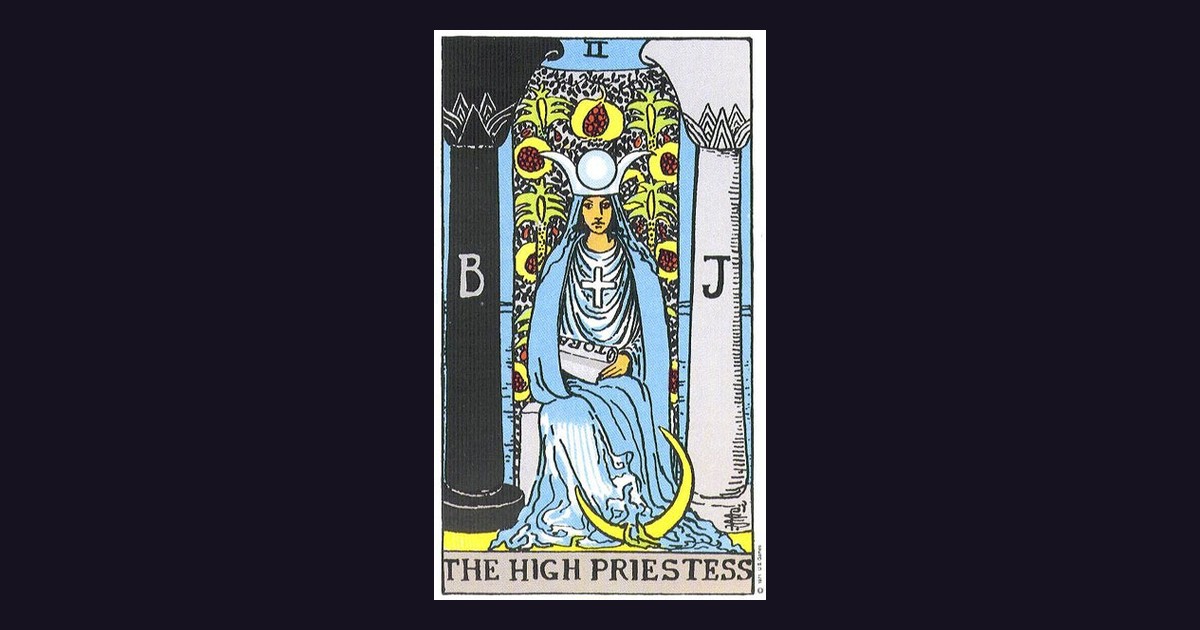
The High Priestess is the tarot’s keeper of the unsaid — card II of the Major Arcana, seated between the black and white pillars with the veil of the temple behind her and the moon at her feet. Where the Magician acts, she knows — and refuses to rush the knowing into words. 🌙
🖼️ The Symbolism
In the Rider–Waite–Smith image every element speaks: the pillars B and J (Boaz and Jachin of Solomon’s Temple) frame the threshold between opposites; the pomegranate veil hides the inner sanctum (and nods to Persephone, queen of the underworld’s rhythms); the TORA scroll sits half-concealed — the law is available but not fully shown; the crescent moon at her feet ties her to cycles, tides and the subconscious. She is the second card because intuition follows will: after the Magician’s “I can,” her “I know.”
⬆️ Upright Meaning
Core: intuition, hidden knowledge, the answer already inside you. The High Priestess appears when the correct move is to listen — to your gut, to what isn’t being said in the room, to dreams and repeated symbols. She counsels stillness before decisions, trusting first instincts, and keeping your own counsel: not every knowing should be spoken yet. In readings she often flags information not yet revealed — wait before committing.
⬇️ Reversed Meaning
Disconnection from your inner voice: overriding gut knowings with spreadsheets, asking everyone’s opinion but your own, secrets working against you (yours or another’s), or intuition drowned by noise and busyness. The reversed Priestess rarely means intuition is wrong — it means it’s unheard. The remedy is silence: journaling, meditation, one honest hour without input.
❤️ In Love
Upright, she signals a connection with depths not yet revealed — often the early phase where fascination outruns information; the counsel is patience and attention to what actions (not words) tell you. For those partnered, she asks what remains unspoken between you — and whether the mystery is intimacy’s spice or its obstacle. Reversed in love: ignored red flags, or intuition about a person you keep arguing yourself out of. Your first read was probably right.
💼 In Career
Upright: unwritten rules matter now — read the room, not just the memo; a mentor with quiet knowledge may appear; research before the pitch. She favours fields of depth: research, psychology, analysis, the healing arts. Reversed: office politics running beneath the surface, or a decision being forced before the full picture is available — stall honourably if you can.
🔗 Working With Her
When she appears, practitioners suggest a 24-hour rule: sleep on the decision and record the first thought on waking (our dream journaling guide pairs perfectly). She sits between the Magician and the Empress on the Fool’s Journey — will, then knowing, then creation. New to reading? Start with our 3-card spread guide. 🔮
Frequently Asked Questions
What does the High Priestess mean upright?
Intuition, hidden knowledge and the answer already within. Listen rather than act, trust first instincts, and wait – information is not yet fully revealed.
What does the High Priestess reversed mean?
Not wrong intuition but unheard intuition: gut knowings overridden, too many outside opinions, secrets in play. The remedy is silence and honest listening.
What does the High Priestess mean in love?
Depths not yet revealed – patience, and attention to actions over words. Reversed, she often marks ignored red flags your first instinct already caught.
The High Priestess and the Shadow Self
The High Priestess, with her veil and hidden scroll, often points to aspects of ourselves that remain unacknowledged or unintegrated – the shadow self. Carl Jung described the shadow as everything we deny about ourselves, both positive and negative, that nonetheless influences our behaviour. When the High Priestess appears, especially in a reading focused on personal growth or self-understanding, she can be inviting us to look beyond the conscious facade. What parts of your intuition do you dismiss as “silly” or “irrational”? What uncomfortable truths about your motivations or desires do you keep hidden, even from yourself? Engaging with the High Priestess in this context means cultivating a brave, non-judgmental space to explore these unseen aspects. This isn’t about immediate action or revelation, but about patient observation and acceptance. Journaling about recurring dreams, automatic thoughts, or strong emotional reactions can be a powerful way to lift a corner of her veil and begin to integrate these hidden parts, transforming them from potential obstacles into sources of deeper wisdom and wholeness.
Cultivating High Priestess Energy: Practical Steps
To actively engage with the High Priestess’s wisdom means consciously inviting stillness and deep listening into your life. This isn’t always about grand gestures; small, consistent practices can yield profound results.
- The “No Input” Hour: Dedicate 60 minutes each day (or as often as possible) to absolute silence and no external input – no phone, no music, no books, no conversations. Simply sit, walk, or perform a quiet task (like washing dishes) and observe your thoughts without judgment. This creates space for your inner voice to surface.
- Dream Recall Ritual: Keep a journal and pen by your bed. Before sleep, set an intention to remember your dreams. Upon waking, resist the urge to immediately engage with your phone or daily tasks. Instead, record any fragments, feelings, or images from your dreams. Over time, patterns and insights will emerge.
- Intuitive Body Scan: When facing a decision, instead of intellectualizing, close your eyes and bring your attention to your body. Where do you feel tension? Where do you feel expansion or lightness? Your body often holds intuitive wisdom that bypasses the rational mind. Pay attention to those subtle sensations.
- Symbolic Observation: The High Priestess deals in symbols. Start noticing repeating symbols, animals, numbers, or phrases that appear in your daily life. Don’t try to force meaning immediately, just acknowledge their presence. Over time, your intuition will begin to connect these dots.
The High Priestess and the Concept of Apophatic Knowing
In spiritual traditions, “apophatic knowing” refers to understanding through negation – knowing what something is by knowing what it is *not*. This concept deeply resonates with the High Priestess. Unlike the Magician who actively defines and manifests, the High Priestess operates in the realm of the indefinable. Her wisdom isn’t about clear-cut answers or logical propositions; it’s about the felt sense, the subtle vibration, the truth that eludes direct articulation. When she appears, she often suggests that the answer you seek cannot be found through rational analysis alone, nor can it be explained away with words. It resides in the space between, in the silence, in the unsaid. Embracing her energy means becoming comfortable with ambiguity, trusting the process of gestation, and understanding that some truths are only accessible through direct, non-conceptual experience. This mode of knowing is profound, often leading to deep personal revelation that transcends the limitations of language and conventional thought.
The High Priestess and the Concept of Apophatic Knowing
In spiritual traditions, “apophatic knowing” refers to understanding something by negating what it is not, rather than by affirming what it is. This concept, prevalent in mystical branches of Christianity (like the Desert Fathers), Buddhism (via concepts like sunyata or emptiness), and Neoplatonism, resonates deeply with the High Priestess. She doesn’t offer direct answers but points to the space where answers arise. Her knowledge isn’t found in a list of facts but in the quiet recognition of what falls away when you stop grasping for certainty. When engaging with the High Priestess, we are invited to practice a form of spiritual inquiry that values silence, paradox, and the unknown. This means letting go of the need for immediate, definitive pronouncements and instead cultivating a comfort with ambiguity. It’s the wisdom found not in “knowing all the answers,” but in understanding the profound depth of what cannot be fully articulated or contained.
Common Misinterpretations and How to Avoid Them
While the High Priestess offers profound guidance, her subtle nature can lead to common pitfalls. Understanding these can help you better navigate her message.
- Passivity vs. Receptivity: A frequent misinterpretation is that the High Priestess advocates for complete passivity or inaction. This isn’t the case. She counsels receptivity – a state of open awareness and listening – before action. It’s about discerning the right moment to move, not refusing to move at all. The difference is crucial: passivity is often fear-based; receptivity is a strength-based alignment with inner timing.
- Secrecy vs. Discretion: The High Priestess holds secrets, but this doesn’t mean she encourages unhealthy secrecy or withholding vital information. Instead, she embodies discretion – the wisdom to know what to share, when to share it, and with whom. Not every nascent idea or intuitive hit needs immediate external validation. Sometimes, allowing a truth to germinate in private strengthens its eventual expression.
- Ignoring Rationality: While she emphasizes intuition, the High Priestess doesn’t dismiss the rational mind. Rather, she suggests that true wisdom integrates both. Her veil doesn’t hide logic; it suggests a deeper layer beyond immediate comprehension. When she appears, it’s an invitation to bring intuitive insight to bear on rational considerations, creating a more holistic understanding rather than abandoning one for the other.
- Spiritual Bypass: In her emphasis on inner knowing, there’s a risk of what psychologists call “spiritual bypass” – using spiritual concepts to avoid addressing unresolved emotional or psychological issues. The High Priestess’s call to look within is an invitation to engage with all aspects of self, including uncomfortable truths, not to escape them. Her hidden scroll is the TORA, representing divine law and wisdom, which often includes confronting difficult realities.
The High Priestess and Mindfulness-Based Stress Reduction (MBSR)
The practices encouraged by the High Priestess find a modern, secular parallel in Mindfulness-Based Stress Reduction (MBSR), developed by Jon Kabat-Zinn. MBSR teaches participants to pay attention to the present moment, non-judgmentally, through practices like body scans, sitting meditation, and mindful movement. This direct, experiential engagement with inner states and external stimuli without immediate reaction is precisely the “listening” the High Priestess advocates. The goal of MBSR is not to empty the mind, but to observe its contents with a calm, detached awareness. This cultivates the very qualities of stillness, self-awareness, and intuitive connection that define the High Priestess. Engaging in MBSR practices, or even just incorporating daily mindful moments, can be a practical pathway to accessing the deeper wisdom she represents, allowing you to hear your inner voice more clearly amidst the noise of modern life.
Historical Echoes: From Isis to Sophia
The archetype embodied by the High Priestess has deep roots across various spiritual traditions. She draws on figures of sacred feminine wisdom who held hidden knowledge and guarded thresholds. In ancient Egypt, the goddess Isis, often depicted veiled, was revered as a mistress of magic, healing, and secret wisdom, possessing knowledge of the divine names and mysteries. Her temples were centers of initiation where esoteric truths were revealed only to the prepared. Later, in Gnosticism, the figure of Sophia (Greek for “wisdom”) represents divine wisdom, often depicted as a primordial emanation of God, involved in creation but also holding secrets of the divine realm. She is sometimes seen as fallen or veiled, waiting to be rediscovered through inner gnosis. These historical echoes underscore the High Priestess’s role not just as an individual’s inner guide, but as a universal symbol of the sacred feminine principle that holds the keys to profound, often unarticulated, truths. Her presence in a reading connects us to this ancient lineage of wisdom keepers.
This page describes what the Tarot tradition teaches and how people practise it. It is not a prediction and not medical, psychiatric or crisis advice. How we research and write · report an error